What we now know as Kultura started as the Philippine Crafts section at the SM Store in Makati in 2004.
Twenty years later, that small section at the department store has grown into 45 branches across the country. Home to traditional and modern Filipiniana and Barong, authentic South Sea and freshwater pearls, souvenirs, local delicacies, sustainable home décor, and natural wellness essentials, Kultura’s expansion has also led to the growth of its suppliers.
“Aligned with the SM group, we work with micro, small and medium enterprises, bridging them to our customers. Many of our partners have been with us from the start,” shares Sheila Tan, senior assistant vice president for Operations, Kultura.
These partners, in turn, provide sustainable livelihood and opportunities that consequently improve the lives of their workers. “We aspire to be the home of social enterprises,” Tan adds.
Social enterprises and conscious consumers
Among Kultura’s long-time partners is Joy Soriano, founder of Zyrrah’s Arts and Crafts. In the 1970s, she began her passion for local handicrafts.
“I started trading handcrafted Philippine products such as bags and shoes using fabrics from the north, designing my shoes and bags and offering them to various foreign friends. However, my first buyer was SM in the Quiapo office,” Soriano shares.
Fast-forward to 2013, and Soriano happened upon Kultura when she participated in a famous trade show. “That was the start of our collaboration. After the first order, we were asked to present samples on a monthly basis. We strived to consistently come up with products for Kultura.”
Initially supplying five Kultura branches, Zyrrah’s Arts and Crafts products are now available in 26 branches.

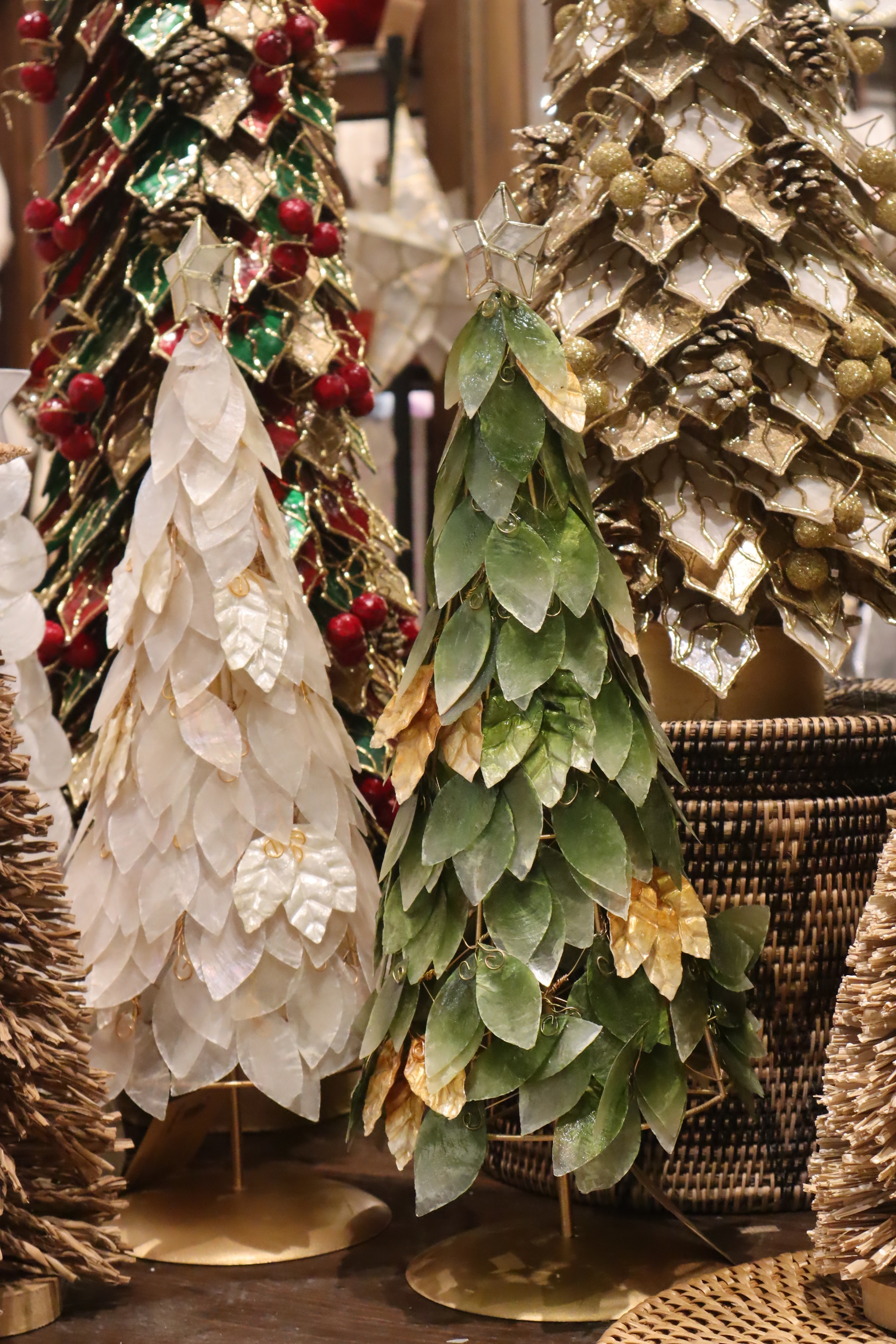
Handcrafted decorations from Zyrrah’s Arts and Crafts are available in Kultura, such as capiz cone trees in white and green.
Soriano shares the same vision and values as Kultura. “We work to contribute to the economy by generating employment for housewives and at-home mothers,” she says. Zyrrah’s Arts and Crafts has a pool of 29 regular in-house capiz makers, a team of quality controllers, and office staff.
Soriano’s passion for capiz is palpable. “I love capiz and the products that we can make and develop out of it. Our country is endowed with bountiful materials from the sea; the versatility of capiz makes for very elegant houseware masterpieces.”
For Soriano, her capiz products also help promote the Philippines as a premium source of fine handcrafted products. She is working on her dream of “getting more orders and employing more people, especially in the barangays.”
Soriano says she doesn’t earn much, but she is “so happy to see that I give to the grassroots.”
Forty years later, Soriano sees that the “local market has increased its potential with various high-end chain of department stores wanting to carry our product line, especially the world-class capiz product range.”
Kultura echoes this sentiment, reflecting a growing movement to support local.
Tan shared, “The attention now is on locally made. Different segments of the market have recognized the artistry of the Filipino craftsman, and their products are becoming more appreciated by locals. Maybe it’s also because millennials and Gen Zs are conscious about sustainability and are more likely to choose eco-friendly products.”
Investing in training, talent
Another partner, Cebu-based Hannah’s Handicraft, found a ready market in Kultura through bazaars and trade fairs under the Department of Trade and Industry (DTI).

Handmade brown pen shell clutch bags from Hannah’s Handicrafts.
Hannah Anggana, the namesake of the handicraft business and daughter of the founders, handles the partnership with Kultura. She shares how they invested time, knowledge and training to be able to produce beautiful products for the store. “We worked to develop products that the market would truly appreciate, and Kultura helped by sharing design trends currently in demand,” Anggana shares.
Hannah’s Handicrafts and Kultura both envision helping preserve and promote Philippine culture while advocating for a cause that honors heritage and empowers communities. “Kultura helps us, and we help the mountain barangays,” Anggana says.
Supporting communities
A group of young millennials, driven by ambition and innovation, started the company Kangkong King. Like with all Kultura partner-MSMEs, their vision was encouraged and supported. “We really want them to expand. We really encourage them to go out and, you know, make the most out of their brand,” Tan says.
Starting with three employees in 2021, Kangkong King now employs around 70. From working in a house kitchen to having their own office and factory, Kangkong King has gone a long way in a short time.
“One underrated, classic Pinoy appetizer is kangkong,” says Anne Gaw, Kangkong King Marketing Head. They banked on the potential of the product to be a staple.

Different flavors of Kangkong King are available in Kultura.
Their partnership with Kultura started with a cold email, a solid belief in their products, and a clear decision about who to partner with. MGaw shares why they took the opportunity to reach out to Kultura.
“We really thought about where we wanted our product to be placed. We think that Kangkong King is very Pinoy. So, one of our goals is to make our product a staple Filipino pasalubong. We thought, ‘What’s the popular pasalubong store in the Philippines? There’s nothing else. It’s Kultura. Locals and foreigners alike know the brand,” Gaw said.
According to MGaw, Kultura also doesn’t have a listing fee. “That is a big help for us as merchandisers.”
Initially supplying to 20 branches, today Kangkong King is available at 70-75 percent of Kultura branches. Gaw further shares, “With Kultura, we’re able to reach Mindanao, Visayas, which was one of our struggles when we started.”
Observing people’s shopping habits inside a Kultura store, Ms. Gaw sees the appeal of a one-stop pasalubong store and how it works to their product’s advantage. “When people go inside Kultura, they have the intention of buying. They look around and find something. So I think that’s what sets Kultura apart.”
Like the other Kultura partners, Kangkong King also works with a community. “We work with partner farmers in Rizal and Pampanga. When we started this business, we didn’t realize the big effect it would have on their livelihood. Now we hear that other landowners are converting their lands to kangkong farms, seeing the opportunity and the demand,” Gaw says.
Showcasing local products, handicraft
In Agdangan, Quezon, a housewives’ weavers association creates buri fans for Kultura. An organization called Mga Likha ni Inay helps these housewives market their products.
“We’re supporting and helping around 1,800 clients, direct and indirect. This includes employees of the clients we’re assisting,” shares Aristopher Punzalan, President of Mga Likha ni Inay.
Punzalan says their vision aligns perfectly with Kultura. “For us, our partnership with Kultura is anchored on showcasing our members’ products to a larger market, which is converted to sales later on. The alignment is really on supporting locals and local produce. We’ve been supporting our traditions and our local products and handicrafts for a long time. I think that’s what Kultura wants. To showcase Filipino products to others.”

Colorful buri fans, made by housewives and at-home mothers, are available in Kultura.
For Punzalan, it helps that “Kultura is at the top of mind for balikbayans and a go-to store for purchasing locally produced crafts and foods.”
As Kultura rings in the new year, the brand hopes to become a place for more emerging MSMEs and talent. “Our thrust for next year will be discovering more young designers and new brands and delivering even more dynamic shopping experiences to our customers.”
The small handicraft store from 20 years ago is doing what it can to stay true to its vision – a home for social enterprises, emerging craftsmen, and dreamers.