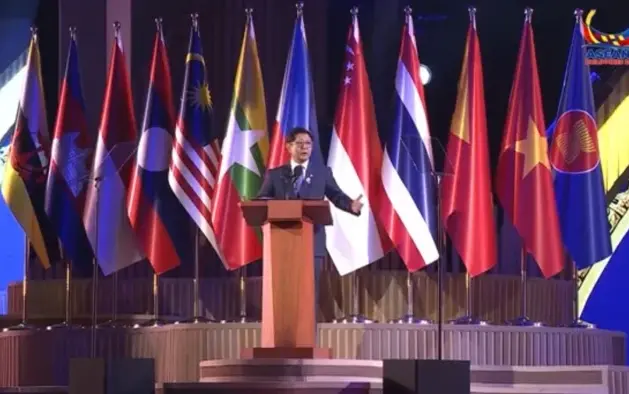
Department of Foreign Affairs (DFA) Secretary Enrique Manalo leads the opening ceremony of the High-Level Conference of Middle-Income Countries (HLC-MICs) at the Makati Shangri-La hotel in Makati City on Monday (April 28, 2025). Manalo urged leaders of participating nations to pursue solutions suited to evolving contexts and needs. (PNA photo by Yancy Lim)
The High-Level Conference of Middle-Income Countries (MICs) commenced on Monday, bringing together representatives to address key challenges and explore strategies to maintain growth amidst global uncertainties.
In his address, Foreign Affairs Secretary Enrique Manalo highlighted that this is the first time the conference has been held in Asia, noting that previous meetings took place in Spain, El Salvador, Namibia, Jordan, Belarus, Costa Rica, and Morocco between 2007 and 2024.
Manalo emphasized that the participation of MICs, including those from the Asia-Pacific region, at this high-level conference underscores the importance of ongoing dialogue to support the growth of middle-income countries. This dialogue aims to develop thoughtful strategies and scalable, impactful solutions.
He further stated, “This reflects the recognition that we need each other. With responsibility for over half of the world’s poor, middle-income countries must rise to both internal and external challenges to meet our national development goals within an acceptable timeframe.”
Manalo urged the leaders to seek solutions that are adaptable to evolving circumstances and needs. He called for a shift away from outdated metrics, financial models, and development assistance frameworks, advocating for more inclusive, empowering, and robust approaches and partnerships.
The Secretary also outlined key priorities for the Philippines: ensuring equitable economic growth through investments in social protection programs, strengthening national institutions based on the rule of law, enhancing access to education, and emphasizing STEM (science, technology, engineering, and mathematics) education to meet the demands of modern economies. He also stressed the importance of integrating climate and biodiversity resilience into policies, supporting industry and small and medium enterprises, and reforming long-standing development partnerships. Additionally, the Philippines aims to take a more active role in South-South and technical cooperation with nations in the Pacific, Asia, Latin America, the Caribbean, and Africa, while striving for greater efficiency within the reformed United Nations development system.
UN Undersecretary-General and Executive Secretary of the Economic and Social Commission for Asia and the Pacific (ESCAP), Armida Salsiah Alisjahbana, echoed Manalo’s points. She noted that MICs represent three-fifths of the global population and economy, playing a critical role in shaping the global path toward sustainable development.
Alisjahbana highlighted that 41 of ESCAP’s 53 members are MICs, which together are home to 75% of the global population and 62% of the world’s poor.
Department of Economy, Planning, and Development (DEPDev) Secretary Arsenio Balisacan stressed the need for an inclusive and responsive international development agenda. “To sustain and accelerate progress, we must embrace dynamic actions that ensure efficient trade transitions, foster resilience, and harness innovation as new drivers of growth,” Balisacan stated.
He emphasized that the Philippines aims to achieve these goals through targeted initiatives, strengthening national institutions, focusing on upskilling and reskilling, integrating climate resilience, and revitalizing partnerships, particularly through South-South cooperation and technical collaborations.
The two-day conference at the Makati Shangri-La Hotel is bringing together leaders and UN delegations for several panel discussions, centered on the theme “Breaking New Grounds Towards a Strategic Plan of Action for Middle-Income Countries.”