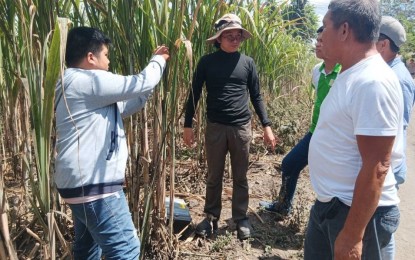
The Sugar Regulatory Administration (SRA) is urging Negros Occidental farmers to adopt the recommended management plan and preventive measures to control the spread of the red-striped soft-scale insects (RSSI).
On Monday, SRA Administrator Pablo Luis Azcona sought the aid of Governor Eugenio Jose Lacson and Victorias City Mayor Javier Miguel Benitez, president of Negros Association of Chief Executives, in promoting the various measures to contain the pest, especially to sugarcane farmers in the 11 affected local government units (LGUs).
“We have secured the help of the Department of Agriculture (DA) in putting in place quarantine measures, but we are also seeking your assistance to advocate among the LGUs and farmers in the province,” Azcona said in separate letters addressed to Lacson and Benitez.
The SRA chief said they are asking farmers to “immediately cordon off infested areas and stop transporting planting materials to other areas until protocols are in place on how best to contain or curb these pests.”
“The RSSI can rapidly spread from one field to another if not contained. This pest poses a significant threat to our crops and can affect yield, which in general can also affect the production of the entire sugar industry,” he added.
Negros Island produces about 65 percent of the country’s sugar output.
The plant disease, which came from infected cane points, is suspected to have been brought to Negros Island from Luzon, where an RSSI infestation was reported before and is still present in some sugarcane farms.
An update from the SRA showed 84.07 hectares of cane fields have been affected since last month, with 65.48 hectares having only “mild infestation.”
The LGUs that reported “slight to severe infestation” are the cities of Silay, Talisay, Victorias, and Cadiz, as well as the municipalities of E. B. Magalona, Manapla, and Toboso in the north, and Murcia in central Negros.
In the south, affected are sugarcane farms in the cities of Bago and La Carlota, and La Castellana town.
“There are reports of a five-hectare area infestation that is now on recovered status, which is why we need to advocate for early monitoring and treatment,” Azcona said.
As preventive measures, the SRA asked farmers to avoid exchanging planting materials, including purchasing, transporting, or moving these between locations.
“If exchange is necessary, ensure insecticide treatment, by soaking, is applied before planting,” it added.
There is also a need to limit field visits, particularly to areas where infestations have been detected, to prevent the spread of pests, and to thoroughly sanitize all materials and equipment after use to maintain a clean and pest-free environment.
For the management plan, the SRA said early detection is important, which can be done through regularly inspection of fields for signs of infestation.
“Pay close attention to the underside of leaves, particularly in the lower sections. Keep in mind that early infestations may not exhibit sooty molds,” it said.
It is also recommended that heavily infested leaves should be detracted, or severely affected canes should be completely removed if sooty molds are present as this would help eliminate unproductive portions and promote plant recovery.
For disposal measures, plants or debris should be immediately removed, or field burning should be conducted after harvest to prevent further spread of the infestation.
Meanwhile, DA-Negros Island Region Director Albert Barrogo said Monday they are facilitating the deployment of pesticide sprayer tankers, including two in Negros and one in Panay, after the Bureau of Quarantine reported that some canes are being transported to Panay from Negros.