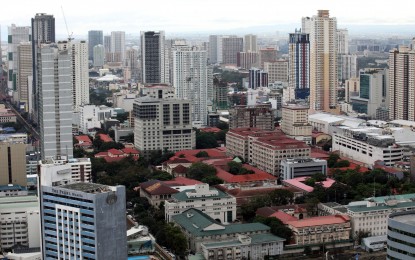

High-rise buildings are photographed as seen from Torre de Manila on Jan. 14, 2025. Philippine economic growth is expected to accelerate to 5.8 percent in the second quarter of the year from 5.4 percent in the first quarter, Bank of the Philippine Islands lead economist Jun Neri said on Friday (Aug. 1). (PNA photo by Yancy Lim)
The Philippine economy may have picked up steam in the second quarter of 2025, buoyed by election-related spending and cooling inflation, according to Bank of the Philippine Islands (BPI) lead economist Jun Neri.
In a market commentary released Friday, Neri projected that the country’s gross domestic product (GDP) likely grew by 5.8 percent from April to June—up from 5.4 percent in the first quarter—fueled mainly by stronger household consumption.
“Consumer spending probably got a major boost from campaign activity, lower inflation—especially with rice prices continuing to fall—and robust growth in personal loans,” Neri said.
He added that exports, particularly of food products, likely gained momentum due to more favorable weather conditions. Meanwhile, electronics exports may have been front-loaded in anticipation of new US tariffs.
However, not all signs pointed upward. Neri warned that election-related bans may have slowed public spending and delayed infrastructure projects, which could partially dampen the quarter’s gains.
On the production side, he noted that reduced electricity consumption may signal softer industrial and commercial activity, creating a slight drag on overall momentum.
Despite these headwinds, Neri remains cautiously optimistic. “While risks persist, the government’s revised full-year growth target of 5.5 to 6.5 percent is still within reach—especially if second-quarter numbers come in stronger than expected,” he said.
BPI continues to forecast a 5.8 percent economic expansion for the full year. But Neri flagged potential downside risks, including typhoon-related disruptions to agriculture and infrastructure, as well as additional tariff hikes from the United States that could affect export performance.
“Any further changes in US trade policy could alter the outlook later this year,” he added.
