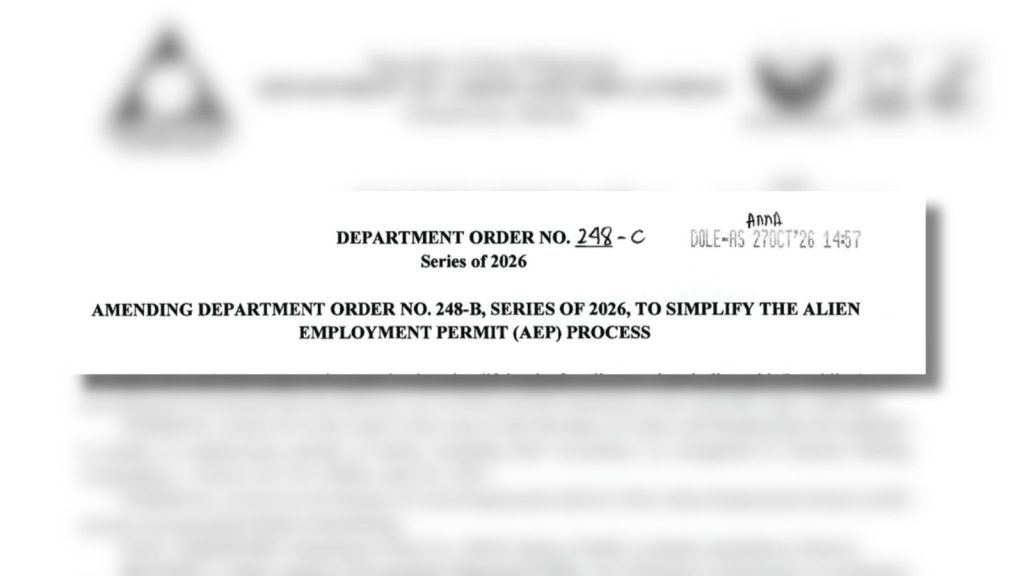

The Department of Labor and Employment (DOLE) has introduced streamlined procedures for Alien Employment Permit (AEP) applications, reducing processing time and documentary requirements to make frontline services faster and more accessible to employers and foreign workers.
Under Department Order No. 248-C, Series of 2026, signed by Labor Secretary Francis N. Tolentino, the new measures aim to simplify application procedures, eliminate unnecessary requirements, and improve the delivery of government services.
One of the major changes is the reduction of AEP processing time from 15 to 10 working days, with a one-time extension of 10 working days when necessary. This brings the maximum processing period to 20 working days.
The order also removes the requirement to submit certain permits and proof of application from other government agencies during AEP filing. However, applicants must still comply with the respective laws and regulations governing these requirements.
In addition, the publication of Labor Market Test notices in broadsheet newspapers at the applicant’s expense has been discontinued. Notices may now be published through the DOLE Official Portal or Public Repository, or filed with the University of the Philippines Law Center.
To further improve accessibility, employers may authorize their human resources officers or other personnel to process applications. DOLE will also collect payment only after an application has passed technical evaluation and received approval.
The new guidelines likewise allow Philippine embassies and consulates to endorse AEP applications to the Bureau of Local Employment or the Department of Foreign Affairs through official notes.
Other provisions include a possible Philippine history and culture orientation for foreign applicants and access to medical care benefits in government hospitals for lawfully employed foreign workers.
The department said the order will take effect 15 days after its publication in a newspaper of general circulation.
Through these reforms, DOLE seeks to strengthen efficient public service while maintaining compliance with Philippine labor laws, supporting President Ferdinand R. Marcos Jr.’s directive to reduce bureaucratic red tape in government transactions.