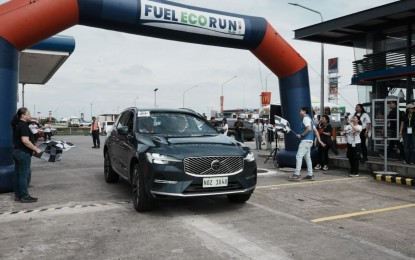

One of the vehicles used during the 2025 DOE-Petron Fuel Economy Run along the Tarlac-Pangasinan-La Union Expressway (TPLEX) on Wednesday (Sept. 24, 2025). Energy Secretary Sharon Garin said the activity is aimed at assessing the energy efficiency of vehicles and in support of the government’s bid to shift to cleaner and sustainable transport solutions. (Photo courtesy of DOE)
Around 70 vehicles of various types—fuel-powered, hybrid, and fully electric—hit the road Wednesday for the 2025 DOE-Petron Fuel Economy Run, an event designed to test energy efficiency and support the government’s transition to cleaner, sustainable transport solutions.
The eco run, held along the Tarlac-Pangasinan-La Union Expressway (TPLEX), featured internal combustion engine (ICE) cars, hybrid electric vehicles (HEVs), plug-in hybrids (PHEVs), and battery electric vehicles (BEVs) covering a 156-kilometer route.
Energy Secretary Sharon Garin stressed that the activity was not a competition but a practical demonstration. “This isn’t a race. It’s about how different vehicle technologies perform under real driving conditions. By providing credible fuel economy data, we’re showing consumers that energy efficiency is both practical and attainable,” she said.
Garin added that the initiative reflects the Bagong Pilipinas spirit, where government, industry, and consumers work together toward energy security, sustainability, and economic efficiency.
According to the Department of Energy (DOE), the eco run is aligned with the Philippine Energy Plan, the Energy Efficiency and Conservation Act (RA 11285), and the Electric Vehicle Industry Development Act (RA 11697). The agency will publish the results on its website for consumers, carmakers, and policymakers.
“These results will serve as benchmarks for government agencies and LGUs in acquiring efficient fleet vehicles under the Government Energy Management Program (GEMP). By shifting to more efficient technologies, we can cut greenhouse gas emissions, reduce reliance on imported fuel, and improve air quality for generations to come,” the DOE said.