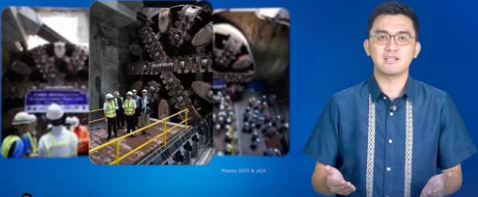

The Department of Budget and Management (DBM) has highlighted major infrastructure and development projects financed through government borrowing, emphasizing that loans must deliver long-term economic benefits while remaining manageable for taxpayers.
Budget Secretary Kim Robert De Leon discussed how borrowed funds are used to finance transportation, rehabilitation, and economic development projects in Episode 17 of the DBM’s information program, “A.S.K. — Alamin Kay Sec. Kim.”
De Leon said understanding how government loans are spent is essential because the public ultimately bears the responsibility of repaying them.
“Kasi aminin natin, kapag may nanghiram sa atin ng pera, gusto nating malaman kung saan ginamit. Lalo na kung tayo rin ang magbabayad!” he said.
Among the projects featured was the Central Luzon Link Expressway (CLLEX) Phase 1, a 30.7-kilometer, four-lane expressway connecting the Subic-Clark-Tarlac Expressway in Tarlac City to Maharlika Highway in Cabanatuan City, Nueva Ecija.
The project was financed partly through a concessional loan from the Japan International Cooperation Agency (JICA), alongside government counterpart funding.
With its final section opened on March 31, 2026, the expressway is expected to improve transportation, facilitate the movement of agricultural products, and support business activities in Central Luzon.
De Leon also cited the Metro Manila Subway Project, which aims to reduce travel time between Ninoy Aquino International Airport Terminal 3 and Valenzuela from more than 90 minutes by road to just over 40 minutes once fully operational.
The subway is projected to accommodate up to 519,000 passengers daily.
Under the proposed 2027 national budget, Php 67.4 billion has been allocated for the project, consisting of Php 26.7 billion in loan proceeds and Php 40.7 billion in government counterpart funding.
Another major undertaking is the North-South Commuter Railway, which is designed to connect Central Luzon, Metro Manila, and CALABARZON through a modern railway network.
The DBM said the project is expected to improve mobility, ease daily commutes, and expand economic opportunities in areas served by the railway.
Beyond transportation, government loans are also being used to support rehabilitation and community development.
In Mindanao, the Reconstruction and Development Plan for Greater Marawi, Stage 2, covers the rehabilitation and construction of 26.59 kilometers of roads, bridges, drainage systems, and slope protection structures.
The project aims to restore essential infrastructure and improve access to schools, workplaces, and public services in communities affected by the Marawi conflict.
“Dahil sa Marawi, hindi lang imprastraktura ang mahalagang maibalik. Kundi pati ang oportunidad at pag-asa ng mga tao,” De Leon said.
In the Visayas, the New Cebu International Container Port Project, financed through a loan from the Export-Import Bank of Korea, seeks to improve cargo-handling capacity and facilitate the movement of goods across the Visayas and Mindanao.
The DBM said more efficient port operations could help businesses reduce logistical difficulties and improve access to markets.
De Leon acknowledged that government borrowing creates financial obligations but said loans can be beneficial when directed toward carefully evaluated investments.
He compared government borrowing to an entrepreneur taking out a loan to expand a business, noting that potential returns, risks, and repayment capacity must be assessed before committing to debt.
“Hindi laging direktang kita sa pera ang balik. Maaari rin itong mas mataas na productivity, mas maraming trabaho, at mas mabilis na paglago ng ekonomiya,” he explained.
However, the budget chief warned against excessive borrowing without proper planning and oversight.
“Hindi puwedeng basta hiram nang hiram! Dapat calculated ang risks, malinaw ang inaasahang benepisyo, at may kakayahang bayaran ang utang,” he stressed.
De Leon said responsible borrowing requires transparency, accountability, proper project implementation, and the ability to meet repayment obligations.
He emphasized that the value of government borrowing should be measured by the actual benefits delivered to the economy and the public, rather than the amount borrowed.
“Ang magandang investment ay hindi nasusukat sa laki ng hiniram, kundi sa tunay na pakinabang at balik nito sa ekonomiya at sa buhay ng mga Pilipino,” he said.
The DBM said it would continue explaining government budget processes and fiscal policies through its public information initiatives to promote greater understanding of how public resources are managed.