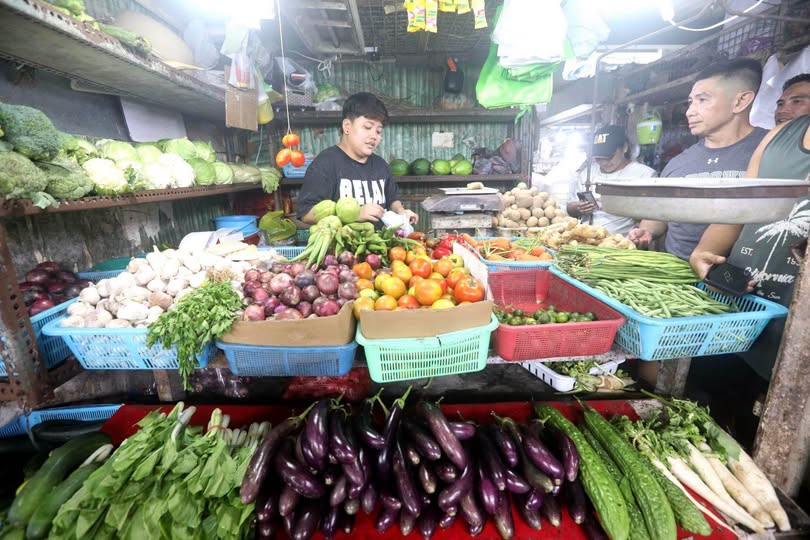

MANILA – The Department of Agriculture (DA) on Thursday vowed to sustain government measures to ease food-price pressure.
This came after food inflation slowed for the bottom 30 percent of income households to 9.4 percent in October, down from 9.8 percent year on year in September, according to the Philippine Statistics Authority (PSA).
In a statement, DA Secretary Francisco Tiu Laurel Jr. said the agency will continue intervention to help reduce costs across the food supply chain.
“Keeping food prices manageable requires not only bringing down costs but also ensuring that farmers can continue producing enough to meet domestic demand,” he said.
Among the DA’s measures are the deployment of fuel subsidies, financial aid to farmers, provision of farm inputs, fertilizers, and insurance, as well as discounts on toll fees.
The administration has also allowed a higher minimum access volume (MAV) for corn to help bring down production costs among poultry and livestock farmers.
“We are also expanding the coverage of Benteng Bigas, Meron (BBM) Na! President Ferdinand Marcos Jr.’s affordable rice program, to help shield vulnerable households, including those with senior citizens, solo parents, and persons with disabilities, from price pressures arising from external shocks beyond the government’s control,” Tiu Laurel said.
He likewise stressed that ensuring a stable and sufficient supply of food will help support food affordability, despite the effects of extreme climate conditions and ongoing geopolitical tensions abroad.
Overall, the DA chief said slower food inflation, like in October, will be sustained by protecting both farmers and consumers.
This means supporting local food producers to meet domestic demands and protect Filipino consumers from “excessive” price spikes in local markets.
In particular, slower increases in October were logged in fish and seafood prices, which eased to 6.4 percent from 8.4 percent.
Vegetables, tubers, and pulses also slowed to 7.9 percent from 9 percent, which helped temper food inflation. Oils and fats also recorded a slight moderation. (PNA/Stephanie Sevillano)