
By Stephanie Sevillano
MANILA – The Philippines will continue to have a sufficient rice supply and inventory of rice and agricultural goods despite the weakening peso against the U.S. dollar and the looming effect of the “very strong” El Niño, according to the Department of Agriculture (DA).
The DA made the remark after President Ferdinand R. Marcos urged Filipinos not to panic amid the historic depreciation of the Philippine peso.
In a press briefing on Thursday, DA spokesperson Assistant Secretary Arnel de Mesa said the Philippines has secured adequate rice supply inventory from both local production and imports.
“We have enough volume and inventory hanggang matapos ang 2026 ng mga pangunahing pagkain na nakarating na sa ating bansa (until the end of 2026– of major food commodities which have entered the country), both imported and, of course, local production,” he said.
“Again, we want to reiterate and reflect the position ng ating Pangulo (of our President Ferdinand R. Marcos Jr.) na sa sektor ng agrikultura, hindi tayo magpa-panic kasi mayroon tayong sapat na pagkain para sa lahat (in the agriculture sector, we will not panic because we have sufficient food supply for everyone),” De Mesa said.
To date, the country has logged 12.1 million metric tons (MT) of local palay (unhusked rice) production from the first to third quarter of the year, according to the Philippine Statistics Authority (PSA).
This is slightly higher than the 11.86 million MT palay output recorded for the same period in 2024, when the Philippines was also hit by the El Niño phenomenon.
In terms of rice imports, De Mesa said the Philippines may easily breach the 5 million MT historic-high mark as the country prepares for the looming effect of extreme drought until the first half of 2027.
“As of October 22, nasa 4.36 million metric tons na ‘yung dumating at ‘yung October, ay nasa (import arrivals is about 4.36 million MT, and in October, it has reached) 253,000 metric tons,” he said.
This is just about 62 percent of the expected volume out of the approved rice imports, but is still higher than arrivals in 2025, as the government imposed a four-month rice import ban to give way for the robust local palay production.
In 2024, the country also hit an all-time high import volume of 4.8 million tons to combat similar effects from El Niño.
“On the consumer side, hindi namin nakikita na problema. Kasi, we have enough volume, inventory ng bigas, ng karne, ng isda. Mga gulay naman natin (we are not seeing the problem. Because we have enough volume, inventory of rice, meat and fish. For vegetables, locally, we have,” he added.
Despite the depreciating peso, the DA assured it will not reach PHP60 per kilogram price levels, but a slight adjustment may be felt in November.
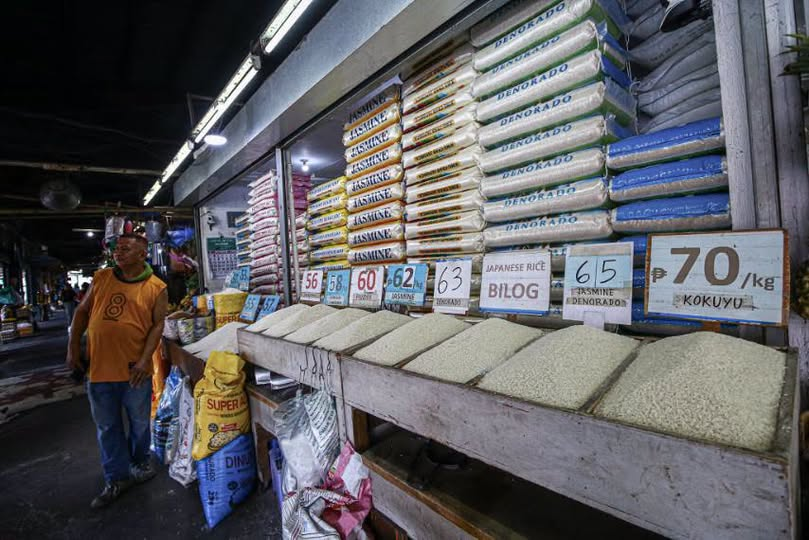
As of Wednesday, prices of imported well-milled rice are pegged at PHP47 per kilogram to PHP50 per kilogram, while imported premium rice is at PHP48 per kg to PHP64 per kg, according to the DA-Bantay Presyo.
*Production intervention*
The DA, meanwhile, stressed that their intervention is focused on local food producers as the combined effects of the extreme heat and sliding peso may affect the cost of production.
Although international prices of imported rice remain cheaper, the weakening peso may affect the landed cost of imported goods, freight expenses, as well as the cost of production for both farm inputs and fertilizers.
To combat this, the government has recently issued Executive Order (EO) No. 129, which increases the corn import quota to 500,000 metric tons (MT) from the existing 220,000 MT.
The initiative is seen to drive down feed prices, with corn being a main ingredient for feeds.
The DA earlier said this measure will not only help address the projected deficit in yellow corn, but also lower feed costs, and help keep meat prices stable for both the livestock and poultry sector.
For palay farmers, the DA reiterated it has prepared alternative income sources in partnership with the Department of Labor and Employment, Department of Social Welfare and Development and Department of Trade and Industry.
These programs include cash-for-work, assistance to individuals in crisis situations, Tulong Panghanapbuhay sa Ating Disadvantaged/Displaced Workers and other alternative livelihoods under DA.
Besides these, the DA earlier assured the distribution of farm inputs, including drought-resistant crop varieties, fuel and fertilizer subsidies, presidential cash aid and toll rebates for truckers, among others. (PNA)