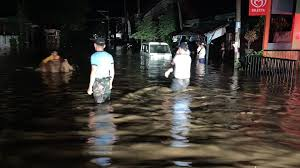

Parts of Davao City were submerged in floodwaters recently despite the city’s congressional district receiving P51 billion in flood control funds from 2000 to 2022.
A brewing budget storm has erupted in Congress after lawmakers discovered that flood control projects—long a staple of local infrastructure funding—have been wiped out from the proposed 2026 national budget, leaving only a sliver of foreign-assisted initiatives intact.
What used to be a bulwark against seasonal devastation has now become the flashpoint of a deepening rift between the House of Representatives and the Marcos administration’s infrastructure priorities.
A historic budget slash
The Department of Public Works and Highways (DPWH), which once commanded one of the largest slices of the national pie, saw its proposed budget shrink from P881.3 billion to just P625.78 billion. Over P250 billion—almost the entire locally funded flood control allocation—was surgically removed following President Ferdinand Marcos Jr.’s instruction to halt new flood control projects pending a review of alleged anomalies.
Only about P15 billion remains, reserved for completing foreign-assisted projects such as the Pasig-Marikina Rehabilitation Project, which the government is contractually bound to finish.
DPWH Secretary Vince Dizon defended the move as part of a broader reset. “Let’s complete what’s already ongoing and fix what’s broken before we pour in more money,” he told lawmakers. “We owe it to the public to make sure these projects actually work.”
Local lawmakers push back
That explanation did little to placate district representatives, who fear their flood-prone constituents will pay the price for the national clampdown. Caloocan Rep. Edgar Erice warned that dredging works long promised to his district will be left to rot.
“That’s unfair,” Erice said. “Our people have been waiting for these projects for years. And now they will be the ones wading in floods next year.”
Cagayan de Oro Rep. Rufus Rodriguez was equally blunt, decrying the abrupt removal of funding for long-planned bypass roads. “Nothing’s left,” he said, noting that the project has already been five years in the making. “We appeal to the DPWH to restore this.”
Dizon hinted the department would explore ways to reinstate some of the defunded items, but gave no guarantees.
Marcos’ gamble: From concrete to policy
The dramatic budget cull is the lowest DPWH submission since 2020 and signals a seismic shift in the administration’s approach to infrastructure—from pouring concrete to recalibrating strategy. The President has framed it as a necessary pause to clean up corruption-ridden programs and transition to “science-based” flood mitigation planning.
Yet for many legislators, the timing is perilous. With the country reeling from increasingly severe typhoons, they warn that withholding flood control funds risks turning next year’s monsoon season into a humanitarian crisis.
The battle over where the money goes
Some allies of the President argue the slashed P250 billion could be better spent on health, education, or other social services. Ilocos Sur Rep. Ronald Singson echoed that view but insisted any reallocated funds must be strictly monitored. “If the money is restored somewhere else, it must be proven that it’s truly needed,” he said.
Behind the budget arithmetic, however, lies a deeper tension: Congress accustomed to delivering flood control projects as local lifelines versus an executive branch determined to dismantle what it sees as a breeding ground for graft.
Whether this marks the start of long-overdue reform or the prelude to disaster will depend on what replaces the vanished flood control billions—and how quickly the government can convince both lawmakers and the public that the country won’t be left underwater.