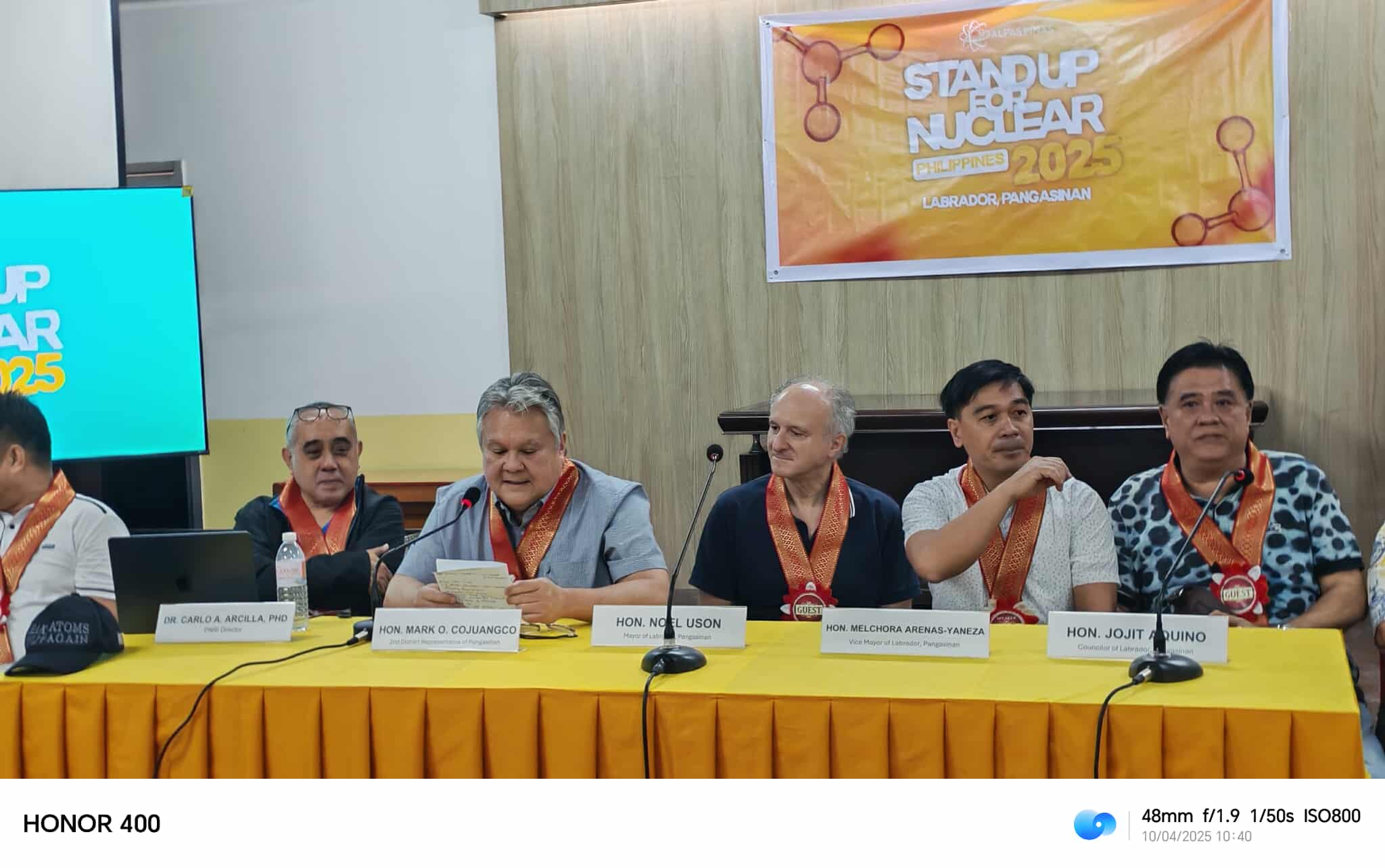

Labrador, Pangasinan — Pangasinan 2nd District Representative Mark Cojuangco has called on the Department of Energy (DOE) to revise the Philippine Energy Road Map by raising the country’s nuclear power capacity target to 16,000 megawatts by 2045, saying that only a bold shift toward nuclear generation can deliver truly affordable and stable electricity for Filipinos.
Speaking before hundreds of residents at a town-hall meeting in Labrador, Pangasinan, Cojuangco — principal author of the newly enacted Philippine Atomic Energy Regulatory Authority (PhilAtom) law — said the government must “think big and act decisively” if it wants to cut electricity costs and end decades of dependence on imported coal and LNG.
“Sixteen thousand megawatts is not an impossible number. It is what the Philippines needs if we are serious about industrialization, job creation, and low power costs,” Cojuangco said. “At that scale, we can bring electricity prices down to around ₱5 per kWh — the cheapest and most reliable in the country — and even provide free power to host communities such as Labrador.”
Labrador eyed as model host site
The town-hall, held with the Philippine Nuclear Research Institute (PNRI) led by Dr. Carlo Arcilla, gathered local officials and residents to discuss how nuclear energy could become the cornerstone of Labrador’s development. Cojuangco said the municipality’s strategic location along the Lingayen Gulf, available land, and openness of its people make it a strong candidate for hosting one of the country’s first modern nuclear power plants.
“Labrador can be a pilot community for safe, clean, and affordable nuclear energy,” he said. “With the right framework, the benefits will cascade — lower household bills, reduced farm and business costs, and a stronger foundation for local industries.”

Mayor Noel Uson welcomed the idea, saying Labrador is ready to embrace the opportunity. “This aligns with our vision of raising our local economy, improving infrastructure, and uplifting lives,” Uson said. “We are committed to working with national partners who share our goal of clean and sustainable energy.”
National momentum and public acceptance
Cojuangco also cited the 2024 Social Weather Stations (SWS) survey showing strong public support for nuclear energy across the country, including Bataan where the Philippine Nuclear Power Plant (PNPP-1) stands. He criticized the DOE for initially withholding the results before releasing them in September 2025.
“The people have spoken — they want cheaper, more stable power and the jobs that nuclear energy can bring,” he said.
He noted that the PNPP-1 site in Morong, Bataan still has space for three additional reactors of 1,100 MW each, which would raise its total capacity to nearly 3,920 MW. Complemented by other government-owned assets — including the Nuclear Village in Bagac, a high-voltage line to Manila, and the Caliraya-Botocan-Kalayaan pumped-storage facility — these can serve as $2-billion worth of equity to secure financing for new plants.
“At ₱5 per kWh, these facilities could generate ₱154 billion a year and save at least $1.5 billion in foreign exchange from avoided coal and LNG imports,” he added.
DOE urged to update roadmap
Under the existing Philippine Energy Plan, nuclear development is penciled in for a modest share of future baseload generation. Cojuangco argued this is insufficient and urged the DOE to formally adopt his 16,000-MW target by 2045, roughly equivalent to 30 percent of the country’s projected power mix by then.
“That target is achievable if we start now,” he said. “It will take more than one administration, but with the PhilAtom law in place, we now have a credible regulatory framework that investors can trust. The Philippines can finally join countries that have made nuclear power the backbone of their prosperity.”
Dr. Arcilla supported the call, stressing that nuclear energy offers both reliability and environmental responsibility. “Nuclear power is clean, cheap, and continuous. By embracing it, we reduce our carbon footprint while ensuring energy security,” he said.
Community benefits and next steps
The dialogue also allowed Labrador residents to ask questions about safety, employment, and environmental impact. PNRI officials assured the public that modern reactor designs meet the highest international safety standards. Potential host communities can expect technical training programs, scholarships, and new business opportunities once projects begin.
For Cojuangco, the message is clear: “If we want to break free from the cycle of expensive electricity, we must take bold steps now. Nuclear power is not just an option — it is a necessity for progress.”
The Labrador forum formed part of the 2025 Stand Up for Nuclear celebration organized by Alpas Pinas, a non-profit group advocating clean nuclear energy. Alpas Pinas convenor Gayle Certeza said the strong turnout in Labrador showed growing public confidence. “What we witnessed today is genuine excitement about how cheaper, more reliable electricity can transform lives,” she said.