
A small but formidable group of companies are leaving their competitors behind in the race to harness artificial intelligence (AI) — and Cisco’s latest AI Readiness Index reveals exactly why.
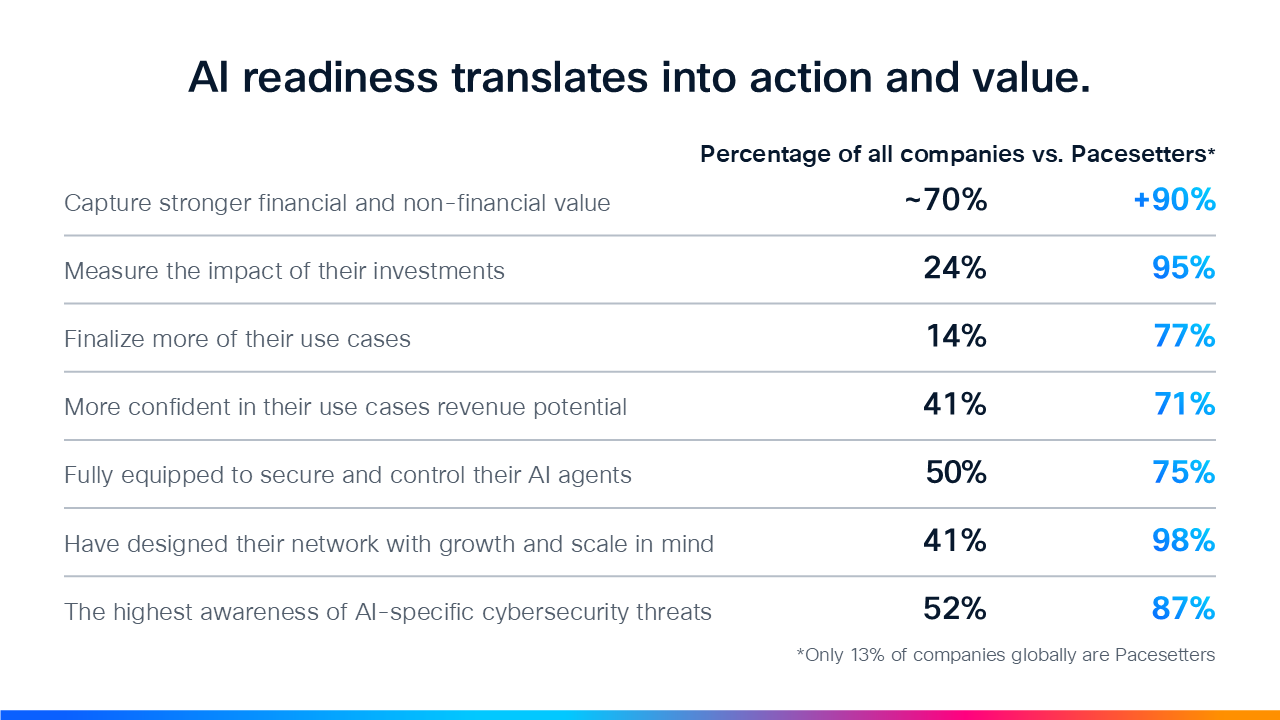
According to the study, dubbed The Race to Value, these “Pacesetters” — roughly 12% of organizations in the Philippines and 13% globally — are six times more likely to move AI pilots into full production and 30% more likely to realize measurable business value. The findings stem from Cisco’s survey of over 8,000 AI leaders across 30 countries and 26 industries.
Zaza Soriano-Nicart, Managing Director of Cisco Philippines, said the research confirms that readiness is no longer optional but essential. “AI-ready organizations — the Pacesetters — prove that discipline, strategy, and infrastructure make all the difference,” she said. “As organizations now move toward deploying AI agents, their success depends on readiness, discipline, and action.”
Cisco’s report paints a clear picture of what separates the top performers. Pacesetters treat AI as a business driver, not a side project. Nearly all (99%) have a formal AI roadmap, while 91% have a change-management plan — far higher than the Philippine averages of 61% and 27%, respectively.
Funding also reflects commitment: 79% of Pacesetters make AI their top investment priority, compared to only 16% locally. Moreover, 96% of them have both short- and long-term funding strategies in place.
Their technological backbone is equally advanced. While only 11% of Philippine firms describe their networks as flexible or adaptable, 71% of Pacesetters have fully scalable infrastructures designed to support any AI workload. About 77% are already expanding data-center capacity within the year.
This readiness translates to speed and measurable outcomes. Three in four Pacesetters have finalized AI use cases, and 95% track impact metrics — four times more than other organizations. The result: 90% report tangible gains in profitability, productivity, and innovation.
In the Philippines, enthusiasm for AI agents is high: 90% of organizations plan to deploy them, and more than a third expect these systems to work alongside human employees within a year. Yet Cisco warns that most companies lack the secure and scalable infrastructure to sustain such operations.
Many networks are not ready for the data and complexity AI agents demand. Nearly 40% of Philippine firms admit their systems can’t handle the workload, and only 11% have adaptive, AI-ready networks. Without foundational upgrades, these ambitions could stall or introduce security risks.
Cisco also introduces a new concept in this year’s report — AI Infrastructure Debt — described as the modern evolution of “technical debt” that once plagued early digital transformations. It refers to the accumulation of outdated systems, deferred upgrades, and underfunded architectures that silently erode AI’s long-term value.
Globally, 45% of companies expect workloads to surge by more than 30% within three years, while 65% struggle to centralize data. Only 19% report robust GPU capacity, and fewer than one in three can detect or prevent AI-specific threats.
These warning signs underscore a widening gap between AI ambition and operational readiness. Cisco notes that Pacesetters, though not immune, mitigate this risk through foresight, governance, and sustained investment — positioning them for long-term resilience and growth.
As AI becomes more agentic and autonomous, Cisco emphasizes that success will depend on trust, security, and adaptability. The research shows that 87% of Pacesetters are highly aware of AI-specific threats, and 62% have already integrated AI into their security and identity systems — twice the rate seen in the Philippines.
In today’s rapidly evolving digital economy, Cisco’s findings offer a clear takeaway: organizations that invest early, think strategically, and build securely will lead the next wave of AI transformation.
“Readiness leads to value,” Nicart said. “And for Filipino enterprises, now is the time to lay the foundation for that future.”