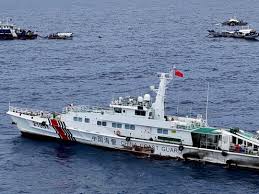

The West Philippine Sea flashpoint extended closer to home on Friday when a China Coast Guard (CCG) vessel was detected hovering just outside Manila Bay—an unusual move that analysts say signals Beijing’s increasingly bold playbook against Philippine vessels.
According to maritime tracker SeaLight, CCG 3306 appeared to be “lying in wait” beyond the 24-nautical-mile contiguous zone, shadowing the Philippine Coast Guard’s BRP Cape San Agustin as it sailed toward the contested Scarborough Shoal. While the ship remained technically outside Philippine archipelagic waters, its presence so near the capital has sparked fresh debate on China’s growing willingness to pressure Manila at sea.
“China is signaling that it can reach even the approaches to Manila Bay if it chooses,” said Ray Powell, founder of SeaLight and a fellow at Stanford University’s Gordian Knot Center. “It’s less about the ship it’s tailing, and more about demonstrating reach and persistence.”
Not just Scarborough anymore
While Chinese vessels frequently shadow Philippine patrols around disputed features, experts note that their creeping proximity to Manila Bay marks a shift in tactics. In recent months, Beijing’s coast guard and militia fleets have been accused of enforcing what analysts call an “exclusion zone” around Panatag Shoal, in defiance of the 2016 arbitral ruling that rejected China’s sweeping maritime claims.
But the new pattern suggests the CCG’s mission may no longer be limited to keeping watch over the shoal. Instead, they appear intent on sending a broader message: that no Philippine deployment headed in that direction will go untracked, even from the country’s doorstep.
“They’ve shadowed fishery vessels before, escorting them out as if to warn, ‘don’t come back,’” Powell noted. “But coming this close to Manila Bay underscores a more audacious approach.”
A growing web of surveillance
Beijing has layered its presence with more than just patrol boats. On the same day, China dispatched the research ship Xiang Yang Hong 10, a deep-sea survey vessel capable of resource exploration and deploying unmanned underwater drones. Though Chinese authorities described a “search and rescue pattern” near Panatag Shoal earlier in the week, Powell dismissed the notion.
“This isn’t a humanitarian drill—it looks more like data-gathering,” he said. “The question is, data for what?”
The collision that sparked it
Tensions have been simmering since Monday’s dangerous encounter off Scarborough Shoal, when CCG 3104 executed a close-in maneuver against the PCG’s BRP Suluan. The risky intercept led to a collision with a People’s Liberation Army Navy warship, leaving both vessels damaged. Philippine officials said the clash was an attempt to disrupt Manila’s “Kadiwa sa Karagatan” outreach, which delivers aid to fisherfolk barred from their traditional fishing grounds.
Satellite data later revealed China had surged eight coast guard and 14 militia vessels in the area in the days leading up to the outreach—an indication, Powell argued, that Beijing had foreknowledge of the operation.
What it means for Manila
For Philippine security planners, the latest episode may be less about the tactical skirmishes and more about the creeping normalization of Chinese presence near critical waterways. By hovering near Manila Bay, China demonstrates that it can project influence not only on contested reefs but also in the approaches to the nation’s capital.
“This isn’t just about fish, shoals, or even ships,” said a retired Philippine Navy officer who asked not to be named. “It’s about psychological pressure. The message is: ‘We’re always watching, even here.’”
For now, the PCG continues its missions, wary of further close calls. But the bigger question is whether Manila is prepared for a future in which Chinese vessels loiter not just in distant reefs but at the edge of its own front door.