

Actress Carla Abellana has become the latest target of a troubling scam involving manipulative food delivery tactics—raising alarms about a recurring scheme that appears to be exploiting trusting customers via food delivery platforms like foodpanda.
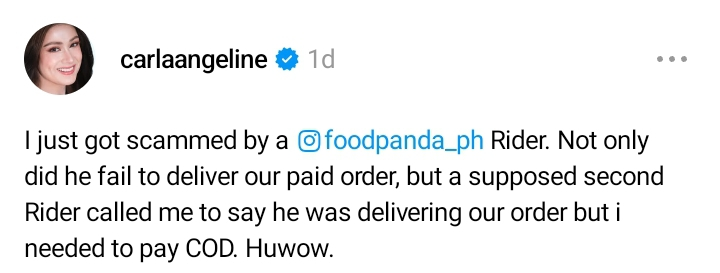
In a recent post on Threads, Abellana recounted how a dishonest foodpanda rider accepted her prepaid order, failed to deliver it, and then a second impostor rider contacted her, claiming the delivery was on its way—but under cash-on-delivery (COD) terms.
“I just got scammed by a [foodpanda_ph] rider,” she wrote. “Not only did he fail to deliver our paid order, but a supposed second rider called me to say he was delivering our order and I needed to pay COD. Wow.”
The scam appears to involve a coordinated bait-and-switch operation, where the original rider vanishes with the food and payment, and an accomplice attempts to double the take by deceiving the customer into paying again.
This isn’t an isolated incident. The comments on Abellana’s post were filled with similar stories, revealing a disturbing trend. Netizens urged her to report the scam to foodpanda, with some expressing frustration over how commonplace this tactic has become.
“Report it to foodpanda so they can refund you and dismiss the rider,” one user advised.
“It’s been a recurring scam. I hope [foodpanda_ph] implements security measures right away,” another added.
The incident underscores a growing vulnerability in the gig economy, where fraudulent actors exploit delivery platforms and the anonymity of riders to target unsuspecting users. While food delivery apps have revolutionized convenience, they have also opened the door for unscrupulous behavior due to identity verification and order tracking gaps.
The scam involving Abellana draws attention to the urgent need for platform accountability, including:
- Verified in-app communication only with riders,
- Stricter ID verification for delivery personnel,
- And real-time delivery tracking with rider validation features.
This follows a similar scam experienced by Kathleen Hermosa, sister of actress Kristine Hermosa, who lost nearly ₱2,000 in a fake product delivery setup—further proof that digital fraud in the Philippines is evolving across platforms and industries.
As these stories surface, the call grows louder for delivery platforms like foodpanda to tighten their anti-fraud systems, protect customers from impostors, and take swift action against rogue riders.
For celebrities and regular users alike, trust in digital platforms must be rebuilt before more fall victim to increasingly clever cons.