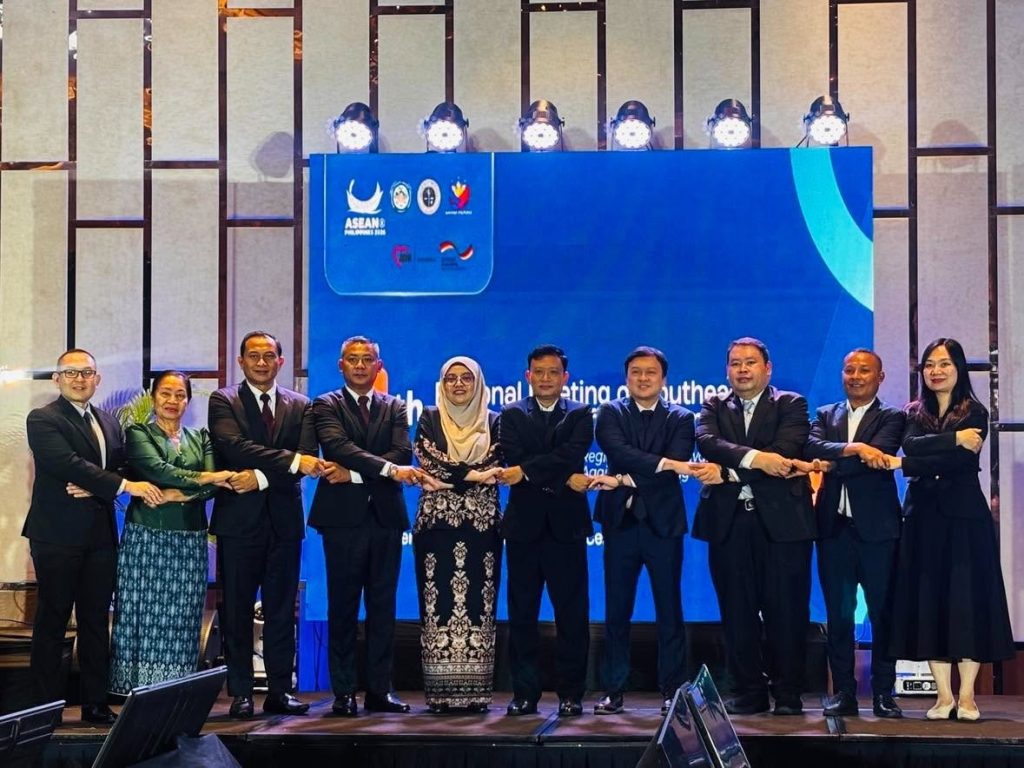

Justice Undersecretary Nicholas Felix Ty (center) and ASEAN delegates attend the 4th Regional Meeting of Southeast Asian National Anti-Trafficking Committees in Lapu-Lapu City.
LAPU-LAPU CITY, Cebu — Anti-trafficking agencies from 10 ASEAN member states have agreed to undertake a joint awareness campaign against fraudulent online job offers used by criminal syndicates to lure victims into scam compounds across Southeast Asia.
The initiative was agreed upon during the 4th Regional Meeting of Southeast Asian National Anti-Trafficking Committees, hosted by the Inter-Agency Council Against Trafficking (IACAT) at Dusit Thani Mactan in Lapu-Lapu City from October 13 to 15.
Held as part of the Philippines’ 2026 ASEAN chairmanship, the meeting brought together regional representatives to strengthen cooperation against human trafficking and cyber-enabled criminal activities.
The campaign, carrying the message “One ASEAN, One Action: Stop the Digital Trap. Break the Chains of Human Trafficking,” will feature social media cards, videos, and other information materials that participating countries can adapt for local audiences.
The materials are scheduled for release in connection with the National Day Against Trafficking in Persons on December 12.
Justice Undersecretary Nicholas Felix Ty emphasized that stronger regional cooperation is necessary to address trafficking networks that exploit digital platforms and deceptive overseas employment opportunities.
“No single nation can put an end to this transnational crime alone. It takes a community of anti-trafficking committees in our region,” Ty said.
He stressed that public awareness and education remain essential tools in preventing individuals, particularly young job seekers, from becoming victims of trafficking syndicates.
Ty urged delegates to establish practical arrangements for faster referrals, improved communication, and information sharing among participating countries.
“A trafficker should never find it easier to cross our borders than an investigator, prosecutor, or a social worker trying to help a victim,” he said.
Ty also cited the Philippines’ experience with offshore gaming operations that had been used as fronts for scam centers where thousands of Southeast Asian nationals were subjected to forced labor.
President Ferdinand Marcos Jr. ordered a ban on Philippine offshore gaming operators, while legislation enacted in October 2025 classified illegal recruitment and exploitation for scam operations as trafficking offenses.
Although the ban disrupted illegal operations in the Philippines, Ty acknowledged that trafficking syndicates continue to operate across national borders.
He said the Philippines assisted in repatriating at least 1,606 trafficking victims in 2025, many of whom had been rescued from scam centers overseas.
Meanwhile, IACAT Secretariat Executive Director Hannah Lizette Manalili warned that trafficking operations have become increasingly transnational, particularly those involving individuals forced to participate in online fraud.
A 2026 United Nations Office on Drugs and Crime threat assessment cited during the meeting found that individuals from more than 80 countries and territories had been identified in scam compounds across Southeast Asia.
Manalili said authorities continue to face difficulties in identifying and assisting victims because of limited resources, lengthy repatriation procedures, immigration penalties, cross-border verification requirements, and language barriers.
Delegates also raised concerns over the difficulty of distinguishing trafficking victims from perpetrators, particularly when individuals initially forced into criminal activities later assume supervisory or recruitment responsibilities.
Participants emphasized the need for careful individual assessments to ensure that victims receive protection while those responsible for criminal offenses are held accountable.
The meeting also explored stronger referral systems, including a possible transnational referral mechanism and an ASEAN-level framework to improve victim identification, protection, and repatriation.
These efforts support the ASEAN Convention Against Trafficking in Persons, Especially Women and Children, which promotes a victim-centered and rights-based approach to combating trafficking.
IACAT Assistant Secretary-in-Charge Michelle Anne Lapuz underscored the importance of sustained cooperation, noting that trafficking networks often recruit victims in one country, transport them through another, and exploit them elsewhere.
“A person is recruited in one country, moved through another, and exploited in a third,” Lapuz said.
“Our shared goal is simple to say and hard to do: to stop the exploitation, to deliver justice that victims can actually reach, and to give survivors real ways to rebuild their lives, including the chance to tell their own stories in their own words,” she added.
The regional campaign will focus on reaching vulnerable individuals, particularly young job seekers, before they become targets of fraudulent online recruitment.
Participating ASEAN countries may adopt the campaign recommendations and customize the materials according to their respective laws and cultural contexts.
The initiative comes amid intensified regional efforts to combat organized crime and online fraud.
During the 20th ASEAN Ministerial Meeting on Transnational Crime held in Makati City on October 20 and 21, regional ministers discussed human trafficking and online scam operations.
Interior Secretary Juanito Victor Remulla, who chaired the meeting, warned that criminal syndicates are exploiting technological advancements and increasing regional connectivity.
“Criminal networks are taking advantage of technology, economic integration, and cross-border connectivity,” Remulla said.
Citing a United Nations Office on Drugs and Crime estimate, Remulla said online scam operations in parts of Southeast Asia could generate approximately US$114 billion in potential annual losses.
The Philippines is expected to present the outcomes of the ministerial meeting during the 49th ASEAN Summit in November.
The Department of the Interior and Local Government also reported that the Philippines retained its Tier 1 classification in the United States State Department’s 2026 Trafficking in Persons Report for the 11th consecutive year.
The Lapu-Lapu City meeting carried the theme “From Shared Concerns to Regional Action: Advancing Awareness and Advocacy Against Trafficking in Persons,” emphasizing the region’s commitment to strengthening prevention, victim protection, and cross-border cooperation.