
By Priam F. Nepomuceno
MANILA – The Armed Forces of the Philippines (AFP) was able to track in real time the Chinese aircraft carrier Liaoning and its escorts when these entered the country’s waters during an exercise last October.
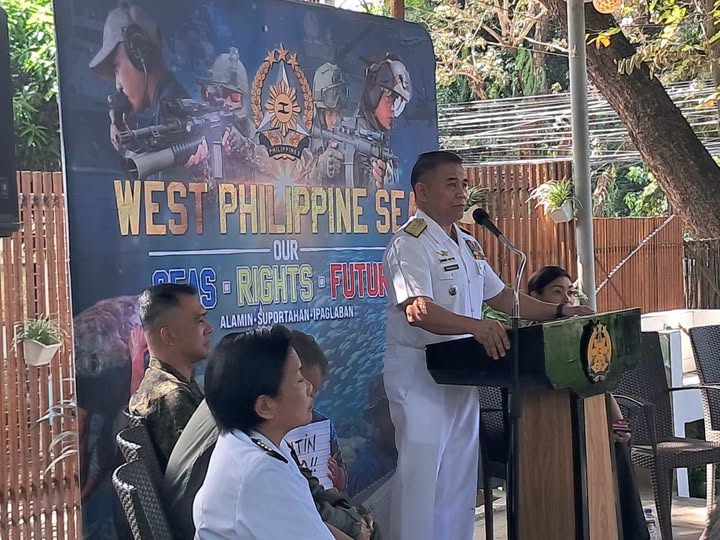
Retired Navy reservist, Rear Admiral Roy Vincent Trinidad, AFP spokesperson for the West Philippine Sea (WPS), in a briefing in Camp Aguinaldo in Quezon City on Tuesday, said the public has nothing to worry about the entry of the carrier and its escorts since it was a regular exercise of the People’s Liberation Army Navy (PLAN).
He said the vessels passage allowed the Philippine military to test for the first time its 360-degree maritime domain awareness capability.
“We were able to hand over the information from Northern Luzon Command to all unified commands that they transited through. We used sea-based, land-based, air-based, and space-based sensors,” he said.
He said the AFP was also able to track the Chinese ships even when its already outside the country’s exclusive economic zone (EEZ).
Aside from military assets, Trinidad also highlighted the role of the “active civilian maritime auxiliaries” who helped in monitoring the foreign naval craft.
“The moment any foreign warships enters our archipelagic waters, napi-pick ito ng ating (these are detected by our) active civilian maritime auxiliaries. And we had almost near real-time tracking of where they were,” he added.
Trinidad said the Liaoning and its escorting ships were detected in Northern Luzon waters on Oct. 14, shortly after transiting from Hainan.
“And on the 16th, (the Chinese carrier group) set sail for the vicinity of Verde Island Passage, where she linked up with two other PLAN surface assets. They (are) now a carrier strike group,” he said.
Shortly after, Trinidad said the Liaoning carrier group transited the country’s archipelagic sea lanes until Oct. 18, with two Chinese warships detaching themselves from the formation.
“The Liaoning and two other warships (then) passed through Basilan Channel on the 20th or 21st. It was there that we monitored the passage close to the shorelines of Zamboanga Peninsula,” he noted.
“The Philippine Navy, through GHQ (General Headquarters), was able to deploy two capital ships. The Philippine Coast Guard was able to deploy their own ship to tail the carrier strike group. It was an inter-agency effort, and I would like to highlight, wherever they are, pag pumasok sa ating (once they enter our) archipelagic waters, we know where they are almost real-time,” he added. (PNA)