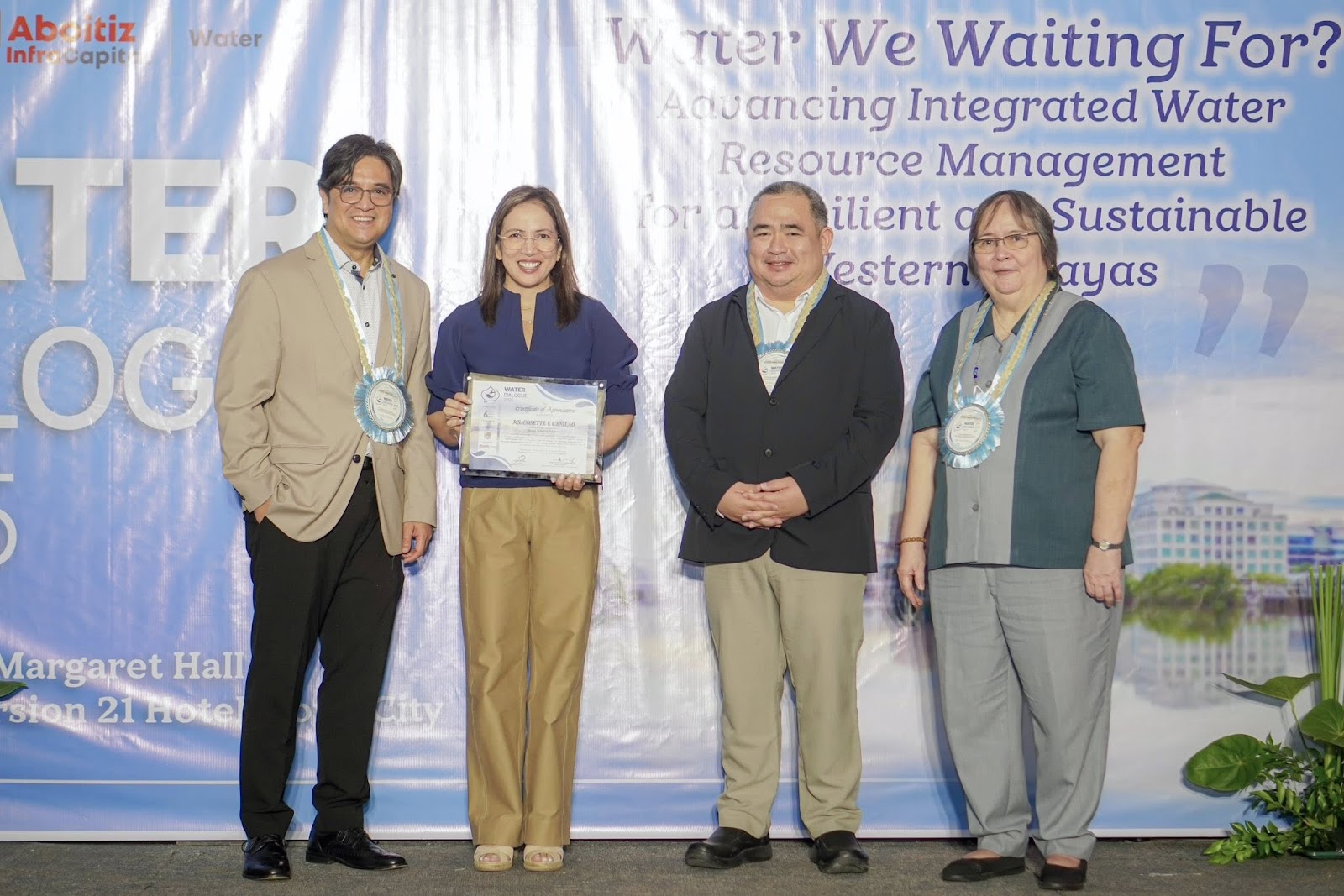

ABOITIZ INFRACAPITAL BATS FOR URGENT WATER INVESTMENTS IN WESTERN VISAYAS. (From left) Iloilo Business Club (IBC) President Emil S. Diez, AIC President & CEO Cosette V. Canilao, DEPDev Region VI Director Engr. Arecio A. Casing, Jr., and IBC Vice President Ma. Luisa C. Segovia at the Water Dialogue in Iloilo City last June 19, 2025. In her speech, Canilao sounded off on the private sector’s call for collaboration and action to collectively and constructively address the region’s water woes.
As Western Visayas faces mounting water insecurity amid economic growth and urban development, Aboitiz InfraCapital, Inc. (AIC) and its water arm, Apo Agua Infrastructura, Inc., joined a powerful coalition of government leaders, business groups, and civil society at Water Dialogue 2025 in Iloilo City on June 19 to chart a clear, unified path forward for the region’s water future.
Hosted by the Iloilo Business Club and the Region VI Regional Development Council—with AIC as co-presenter—this year’s dialogue centered on the theme, “Water We Waiting For? Advancing Integrated Water Resource Management for a Resilient and Sustainable Western Visayas.” The event served as both a call to action and a platform for sharing innovative approaches to sustainable water management.
‘Water can’t wait’
In the event’s opening plenary, AIC President and CEO Cosette V. Canilao delivered a direct and urgent message: the time to act is now.
“Where water flows, progress follows. And if there’s one thing the present demands of us, it’s this—we must not wait,” said Canilao.
She highlighted the transformative success of AIC’s Davao City Bulk Water Supply Project (DCBWSP) through its subsidiary, Apo Agua. A partnership with the Davao City Water District (DCWD), the project now delivers 300 million liters of clean water daily to over a million residents—round the clock.
One of the keys to its success? A clear division of responsibilities. While AIC oversees bulk water production, DCWD manages distribution—eliminating potential conflicts of interest and boosting transparency.
“This isn’t just infrastructure—it’s governance in action. It’s a scalable model that can work not just in Davao, but here in Iloilo, and in other cities grappling with similar challenges,” Canilao explained. “Redundancy builds resilience, and a diverse set of providers drives better service for our communities.”
The water sector’s common pitfalls—fragmentation, lack of coordination, and blurred accountability—were at the heart of the discussion. Canilao called attention to the newly revised Public-Private Partnership (PPP) law, emphasizing how it empowers private investors to take real financial and operational risks, rather than act as mere intermediaries.
“This is the kind of risk-sharing we need for real change,” she added.
The local perspective
Iloilo City Mayor Jerry P. Treñas emphasized that without adequate water infrastructure, both quality of life and investor confidence are at risk.
“Water is not a tomorrow problem—it was a yesterday need,” Treñas said. “I believe that by partnering with the private sector, we are investing in long-term solutions for a water-secure future.”
The water crisis isn’t limited to the city. Iloilo Provincial Administrator Raul N. Banias, standing in for Governor R. Arthur Defensor Jr., revealed that nearly half of households in the province still lack access to clean water. To address this, the provincial government has committed roughly P70 million to enhance local rural water systems.
Bridging the national-local divide
Canilao stressed the importance of aligning national strategies with local needs—urging deeper collaboration among agencies like the National Water Resources Board, Department of Finance, and the PPP Center, in partnership with local governments.
“Top-down must meet bottom-up,” she said. “Local governments live the reality of water insecurity every day. Their knowledge and proximity to communities are invaluable in shaping workable solutions.”
Department of Economy, Planning, and Development Undersecretary Carlos Bernardo O. Abad Santos agreed, noting that private sector partnerships remain critical in closing the infrastructure and service delivery gaps that have long plagued the water sector.
The Davao model as a roadmap
In a breakout session on water innovations, Apo Agua General Manager Ronnie D. Lim offered deeper insights into how the DCBWSP changed Davao’s water story. He highlighted its pioneering water-energy nexus approach, where water used to generate hydropower is simultaneously treated and distributed for public consumption.
“Understanding the full water cycle—from sourcing to treatment to delivery—has allowed us to design systems that are both sustainable and scalable,” Lim said.
As of the end of 2024, the DCBWSP had extended service coverage to 96% of Davao City and earned a 99.6% customer satisfaction rating—figures that speak volumes about what’s possible when innovation meets accountability.
A defining moment for Western Visayas
The Water Dialogue 2025 didn’t just shine a spotlight on the region’s pressing water issues—it also presented a roadmap filled with practical solutions, actionable frameworks, and proven models.
The message was clear: to sustain the economic momentum of Western Visayas, water must be at the center of its development agenda. And with public-private partnerships, clear governance, and the right investments, a water-secure future is within reach.