
By Stephanie Sevillano
MANILA – The Department of Agriculture (DA) on Monday said it imposed a 60-day import ban on certain pork products to help Filipino hog raisers recover.
This follows the DA’s release of Department Order (DO) 33 over the weekend, as the local hog sector sustained PHP28 billion in losses due to the influx of cheaper imported pork meat in the Philippines.
In 2025, the DA said pork imports rose 42 percent to 836,240 metric tons (MT) from 589,675 MT in 2023.
Imports also accounted for a larger share of domestic production, rising to 65 percent in the first half of 2026 from 61 percent in 2025 and 39 percent in 2021.
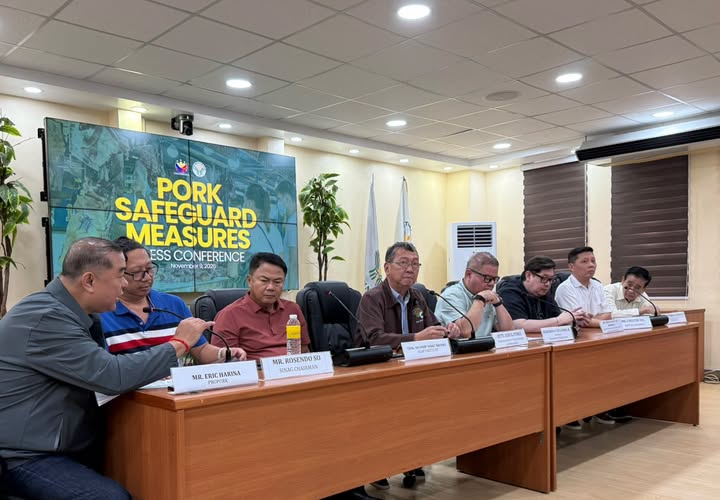
In a press conference, DA Secretary Francisco Tiu Laurel Jr. said the temporary import suspension is one of the government interventions to protect local small-scale to commercial hog raisers.
“Ang hope namin ay tumaas ng (Our hope is to increase it by) PHP50 at least or a little bit more. But sa ngayon kasi, ang hangad lang naman mawala lang ang lugi (for now, our hopes are to eliminate the losses),” he said.
“Alam niyo, mataas ang presyo ng lahat ngayon. Pero hindi rin dapat malugi ang industriya (You know, the prices of everything now are high. But our industry must not suffer losses). So, for people to break even, to make a little money, I think it’s fair at this time.”
Tiu Laurel, meanwhile, assured the industry that the 60-day period is flexible and may be extended based on the sector’s needs, particularly the actual level of farmgate prices.
“Farmgate price, if it is lower than their breakeven cost or breakeven lang sila (they are just breakeven), then we will extend,” Tiu Laurel said.
To date, the breakeven cost is around PHP165, but average farmgate prices are only pegged at about PHP140 per kilogram for backyard live pork and PHP150 per kg for commercial pork.
Under DO 33, shipments covered by the temporary suspension include fresh, chilled and frozen swine meat, such as carcasses and half-carcasses; hams, shoulders and cuts with bone in; and fresh, chilled, and frozen edible offal like livers and others.
The import ban is effective on Nov. 24 or 15 days after publication.
Welcome measure
The National Federation of Hog Farmers, Inc. in the Philippines (Natfed), Propork Federation of the Philippines, Samahang Industriya ng Agrikultura (Sinag), and Agap party-list, among others, welcomed the temporary measure of the agency to cushion the effects of what they call “oversupply” of imported meat.
“Nagpapasalamat kami sa DA doon sa 60 days na suspension. Malaking tulong po iyon (We thank the DA for the 60-day suspension. That’s a huge help),” Natfed chairperson Chester Tan said.
He also called on the Tariff Commission (TC) to restore the original rate on imported pork to 30 percent for in-quota and 40 percent for out-quota.
“Kung kailangan po namin magmakaawa, lumuhod sa tariff commission economic managers, gagawin po namin kasama ang opisina ng (If we need to plead, kneel before the tariff commission economic managers, we will do it with the) Department of Agriculture,” Tan said.
“Gusto pa rin natin na itaas ‘yung tariff. Iyong tariff pa rin na ibalik sa 30 to 40 percent ang importante (We want the tariff increased. What’s important is to bring back the tariff to 30 to 40 percent,” Sinag chairperson Rosendo So said.
Agap Party-list Rep. Nicanor Briones, meanwhile, commended the agency’s move to include pork jowls as swine meat to further protect the local hog industry.
“Maganda ‘yung recommendation nila para sa pork jowls na gawing pork meat at i-increase ‘yung (Their recommendation for pork jowls to be considered as pork meat and increase) tariff from 10 percent to 40 percent,” he said.
Tiu Laurel said they are hoping to have the decision on a proposal for pork jowls before the end of the year.
On tariffs on imported pork, he said they are still awaiting the TC assessment and decision following their request to restore the original tariff on Sept. 25.
“Sept. 25 was the date. Also, November pa lang, it’s still going through the motions of public consultation,” Tiu Laurel said in a separate ambush interview.
Alongside the proposed tariff restoration, the DA is also working on hog repopulation and vaccines against African swine fever (ASF).
Besides the earlier approved ASF vaccine for commercial use, the DA is eyeing two more vaccines from the United States and South Korea. (PNA)