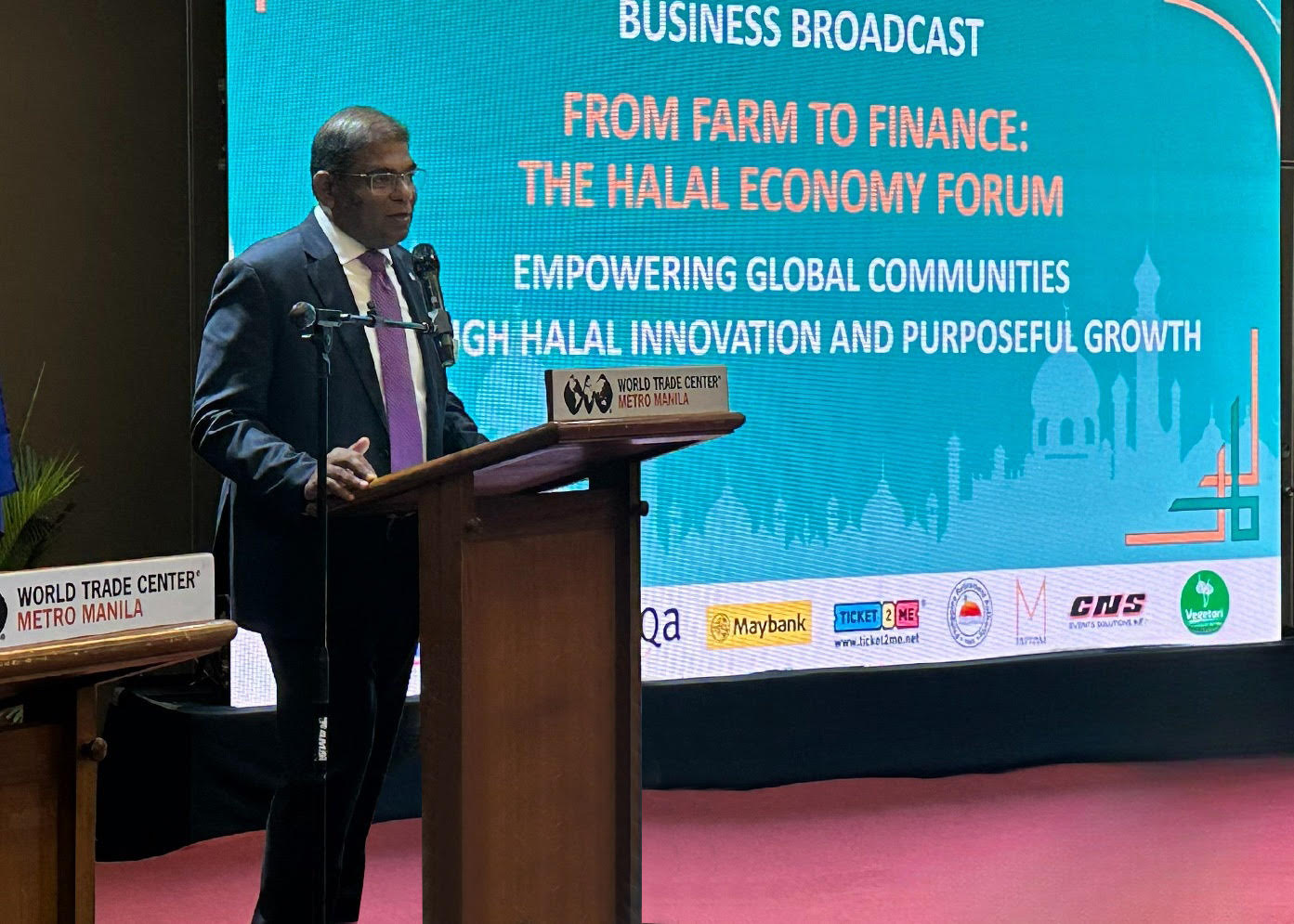

Malaysian Ambassador H.E. Dato’ Abdul Malik Melvin Castelino highlighted the potential for ASEAN-wide cooperation on Islamic finance standards, which could facilitate cross-border capital flows and regional financial integration.
The World Trade Center Metro Manila (WTCMM) gathered government leaders, industry experts, and business owners for the Business Broadcast: The Halal Economy Forum – From Farm to Finance, a one-day event that unpacked the expanding opportunities within the global Halal ecosystem. More than a hundred participants attended the forum, which traced the Halal value chain from agriculture and food production to banking, finance, and investment.
Speakers emphasized a central point throughout the discussions: Halal is no longer merely a religious label but a strategic economic pillar. As officials noted, a thriving Halal ecosystem represents a pathway toward inclusive growth, food security, ethical finance, and stronger global market competitiveness.
In the Philippines, interest in Halal continues to surge, driven by demand not only from local Muslim communities but also from high-value export markets across the Middle East, Southeast Asia, Europe, and North America. With its agricultural strengths and advantageous geographic location, the country is increasingly seen as a potential Halal hub in the Asia Pacific region.
The morning session focused on food production and the opportunities that small and medium enterprises (SMEs) can unlock through Halal certification. Mubarak Fresh Foods’ Juhainah Javier shared how her business went from selling two kilos of product a day to over 100 kilos daily after securing Halal certification—an example underscoring how compliance can open institutional and export doors for local producers.
Department of Agriculture Undersecretary for Regulations and Infrastructure Engr. Zamzamin L. Ampatuan highlighted that strengthening Halal food production can advance food security, empower rural communities, and enhance the country’s export potential. He reaffirmed government support for Halal-compliant infrastructure, citing the ₱350-million poultry facility being developed in Tarlac.
Ampatuan noted that domestic Halal food demand now exceeds ₱6.6 billion each year, with dairy, beef, and poultry making up nearly 90% of nationwide consumption. He urged stakeholders to invest in scaling production, aligning agricultural programs with global standards, and addressing gaps in certification and logistics.
A panel discussion followed, featuring experts who outlined practical steps for businesses that want to enter or expand within the Halal value chain—whether through certification, product diversification, or strengthening logistics and cold-chain systems.
The forum shifted to Halal finance in the afternoon, beginning with a clear and accessible presentation from Bangko Sentral ng Pilipinas’ Atty. Arifa Alah. She explained the distinctions between conventional and Islamic banking and highlighted how both systems can support entrepreneurs seeking capital to grow their ventures.
Malaysia’s Ambassador to the Philippines, Dato’ Abdul Malik Melvin Castelino, delivered the keynote address, stressing that Islamic finance is not niche but a scalable, ethical model that broadens access and deepens investor confidence. Citing Malaysia’s success with its dual banking system, he underscored how Islamic finance can coexist with conventional structures to support inclusive development.
Dr. Aleem Siddiqui M. Guiapal, Program Head of the Philippine Halal Industry Development at the Department of Trade and Industry, called for institutionalizing Islamic finance to help channel ethical capital toward Halal enterprises. He pointed to the Philippines’ successful $1-billion Sukuk bond issuance in 2023 as proof of rising investor interest.
A second panel discussion capped the afternoon, where experts answered questions on Islamic banking, financing tools, and Takaful (Islamic insurance). The session clarified how businesses can tap Shariah-compliant financial products to expand operations or strengthen risk protection.
The entire forum echoed the goals of the Philippine Halal Industry Development Strategic Plan 2023–2028, which aims to double Halal-certified output, create 120,000 jobs, and generate ₱230 billion in investments. With more than 3,000 certified products and strong momentum in Muslim-friendly tourism, the Philippines is gradually carving out its position as a regional Halal player.
Supported by the Department of Trade and Industry–Halal Office, the Bangko Sentral ng Pilipinas, Maybank Philippines, Etiqa Philippines, Miguelitos, and M Catering, the event demonstrated the collective commitment to harnessing the Halal economy as a driver of national progress.
As part of the WTCMM Business Club’s Business Broadcast series, the Halal Economy Forum reaffirmed WTCMM’s role as a hub for dialogue, learning, and collaboration. By bringing together policymakers, entrepreneurs, and industry leaders, the event enriched the national conversation on building an economy rooted in ethics, inclusivity, and sustainable growth.
Through its Business Broadcast platform, WTCMM continues to empower the country’s business community—strengthening capacities, bridging knowledge gaps, and opening pathways for Filipino enterprises in an increasingly competitive global market.