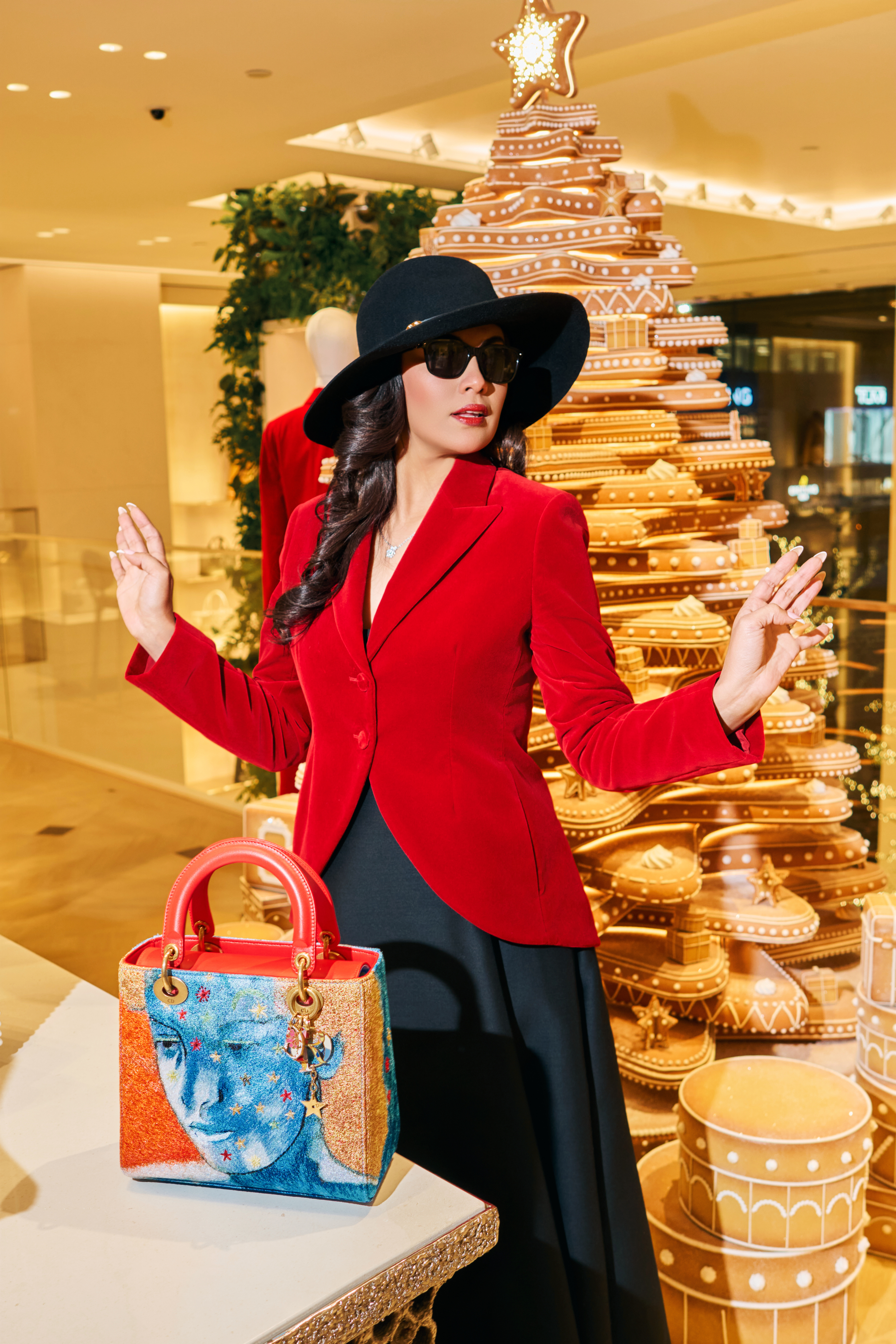

Some fashion moments feel less like personal styling and more like destiny revealing itself—quiet, precise, and unmistakable. For Diana Qeblawi, that moment arrived in New York during the Lady Dior Art 10th Anniversary cocktails, an intimate evening hosted inside the House of Dior that celebrated a decade of turning an icon into a living canvas.
The Lady Dior Art project has always occupied a singular place in the maison’s universe. Each edition invites artists to reinterpret the Lady Dior bag as an artwork, blurring the boundary between fashion object and collectible piece.
For its tenth anniversary, ten artists were chosen, each bringing a distinct visual language to the house’s most emblematic silhouette. The setting felt more like a gallery than a party—hushed, reverent, and charged with meaning.
Diana entered the room dressed entirely in Dior, her look composed with restraint and clarity. A fitted red cotton-velvet jacket caught the light in the house’s signature rouge, layered over a flared black wool-and-silk shantung dress that subtly echoed Dior’s New Look heritage.
Accessories were deliberate and pared back: a black rabbit-felt D-Muse wide-brim hat, square black sunglasses, patent pointed-toe slingbacks, and a near-whisper of diamonds from the Rose Dior Bagatelle collection.

Yet the true center of gravity was what rested on her arm.
She carried the Medium Lady Dior Art bag by Inès Longevial, rendered in cotton canvas and fully embroidered with hand-stitched stars. The bag felt less like an accessory and more like a constellation brought into form. “I wanted everything else to be a frame,” Diana would later say. “The bag was the story.”
That decision was intentional. The evening was never about spectacle. It was about honoring artistry, craftsmanship, and the belief that fashion can carry memory and meaning. Longevial’s stars, which the artist describes as symbols of forgotten dreams, hold particular resonance. Without them, the piece would fall silent; with them, it becomes luminous.
For Dior, the star carries its own mythology. In 1946, Christian Dior famously found a metal star on the street and took it as a sign to begin his maison. Since then, stars have appeared throughout the house as quiet talismans of destiny. In Longevial’s design, Diana saw two narratives converging. “Inès’ stars and Monsieur Dior’s stars stitched together—it feels like fate,” she reflects. “Two stories meeting on the same canvas.”
That sense of fate has long defined her relationship with the Lady Dior. Named after Princess Diana, Diana Qeblawi grew up watching the Princess with her family, absorbing her elegance and quiet strength. She remembers being seven or eight years old when she first saw Princess Diana carrying the Lady Dior, always in the medium size. “I remember thinking, one day I want to carry that bag the way she did,” she recalls.
It was never about trends. It was about continuity, heritage, and a promise to herself. Her first Lady Dior—a fuchsia printed calfskin version embroidered with multicolored pearls and threads—marked the beginning of a deeply personal collection. Over time, the medium Lady Dior became her constant, the very size Princess Diana made iconic. She even owns the black version once carried by the Princess. “The moment I held it,” she says, “everything felt full-circle.”
That feeling of completion only deepened during the anniversary cocktails. Although Diana had discovered Longevial’s work only earlier this year, the connection was immediate. When Dior unveiled the star-embroidered design for the tenth edition, she knew—without hesitation—that it was meant for her. “Sometimes,” she says, “the universe lines everything up perfectly.”
Throughout the evening, guests were drawn to her with genuine curiosity. They leaned in to examine the embroidery, asked to photograph the bag, and listened as she shared its story. One guest summed it up simply: “Tonight, you are the exhibition.”
The atmosphere matched the sentiment. Original sketches lined the walls, and the bags were approached with the care reserved for museum pieces. Diana spent the night in conversation with artists and Dior artisans, listening to stories of hand-placed stitches, inherited techniques, and creative faith. There were no red carpets or theatrics. “The real stars were the bags,” she says. “And the people who made them.”
As for what comes next, Diana is in no hurry. She is waiting for the next Dior piece that brings the same quiet certainty—medium in scale, rich in meaning, and unmistakably destined. For now, she is content to remain exactly where she is.
After all, when you have already stepped into your own constellation, there is no need to chase another star.
