
(Photo courtesy of PNA)
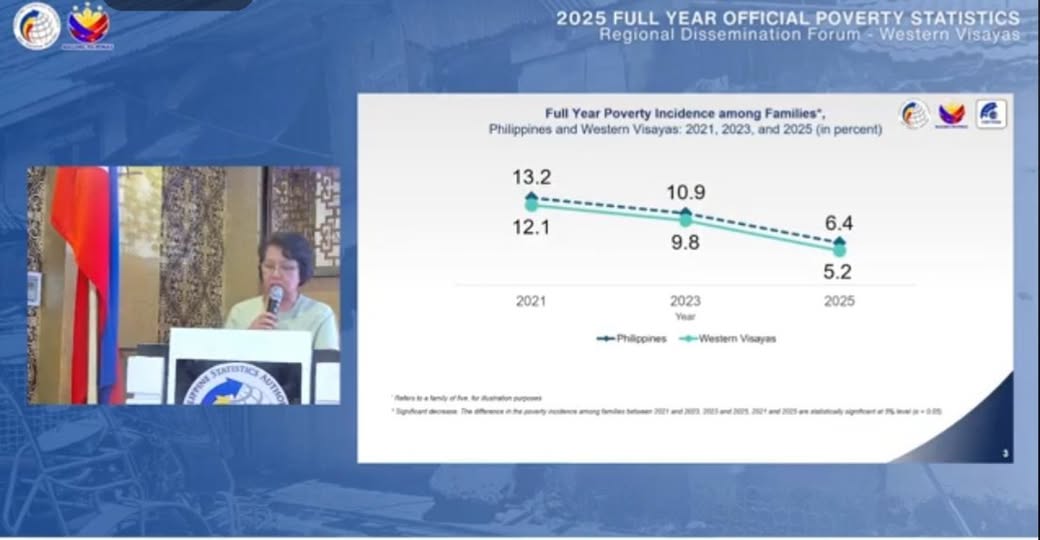
ILOILO CITY – Poverty incidence among families in Western Visayas fell to 5.2 percent in 2025 from 10.9 percent in 2023, reflecting significant improvements in household income and living conditions across the region, the Philippine Statistics Authority (PSA) reported Tuesday.
The proportion of individuals living below the poverty threshold also declined to 7.7 percent in 2025 from 13.7 percent in 2023 and 17.2 percent in 2021.
The latest poverty estimates were based on the 2025 Family Income and Expenditure Survey (FIES) and prevailing prices of food and non-food commodities. The survey covered 8,512 families, compared with 7,914 in 2023.
Marlene Alviar, chief statistical specialist of PSA-Western Visayas, presented the findings during the regional dissemination forum on the 2025 Full-Year Poverty Statistics.
“In 2025, the poverty incidence among families in Western Visayas was estimated at 5.2 percent. For estimation purposes, the family is assumed to have five members. This means that about five in every 100 families were considered poor in 2025,” Alviar said.
The latest figure marked a substantial improvement from the 12.1 percent recorded in 2021 and 10.9 percent in 2023.
The number of families classified as poor dropped to approximately 68,000 in 2025 from 119,000 in 2023 and 141,000 in 2021.
Meanwhile, the number of individuals living below the poverty threshold decreased to around 378,000 in 2025 from 664,000 in 2023 and 820,000 in 2021.
“This means that around eight in every 100 Filipinos in the region had incomes below the amount needed to afford their minimum basic food and non-food needs,” Alviar said.
“With this, over 442,000 who were previously poor gained enough income to move out of poverty since 2021,” she added.
The PSA also recorded improvements in poverty incidence across all provinces in Western Visayas and Iloilo City.
Department of Economy, Planning and Development (DEPDev) Western Visayas Regional Director Casing Jr. described the decline as statistically significant, highlighting faster income growth among lower-income households.
“Income rose across all income groups, and those in the lowest-income families grew faster. The gains, in other words, were not limited to those who were already better off,” he said.
Casing attributed the improvement partly to financial assistance from relatives in the Philippines and abroad, alongside government programs providing support to vulnerable households.
He encouraged government agencies, private sector organizations and civil society groups to use the latest poverty statistics in development planning, budget allocation and the identification of beneficiaries for assistance programs.
“The 2025 result tells an encouraging story: fewer families in Western Visayas were living below the poverty threshold than in 2023. Our task moving forward is clear: protect these gains. We aim to reach the families who have yet to benefit and ensure that progress reaches every family in Western Visayas,” Casing said.