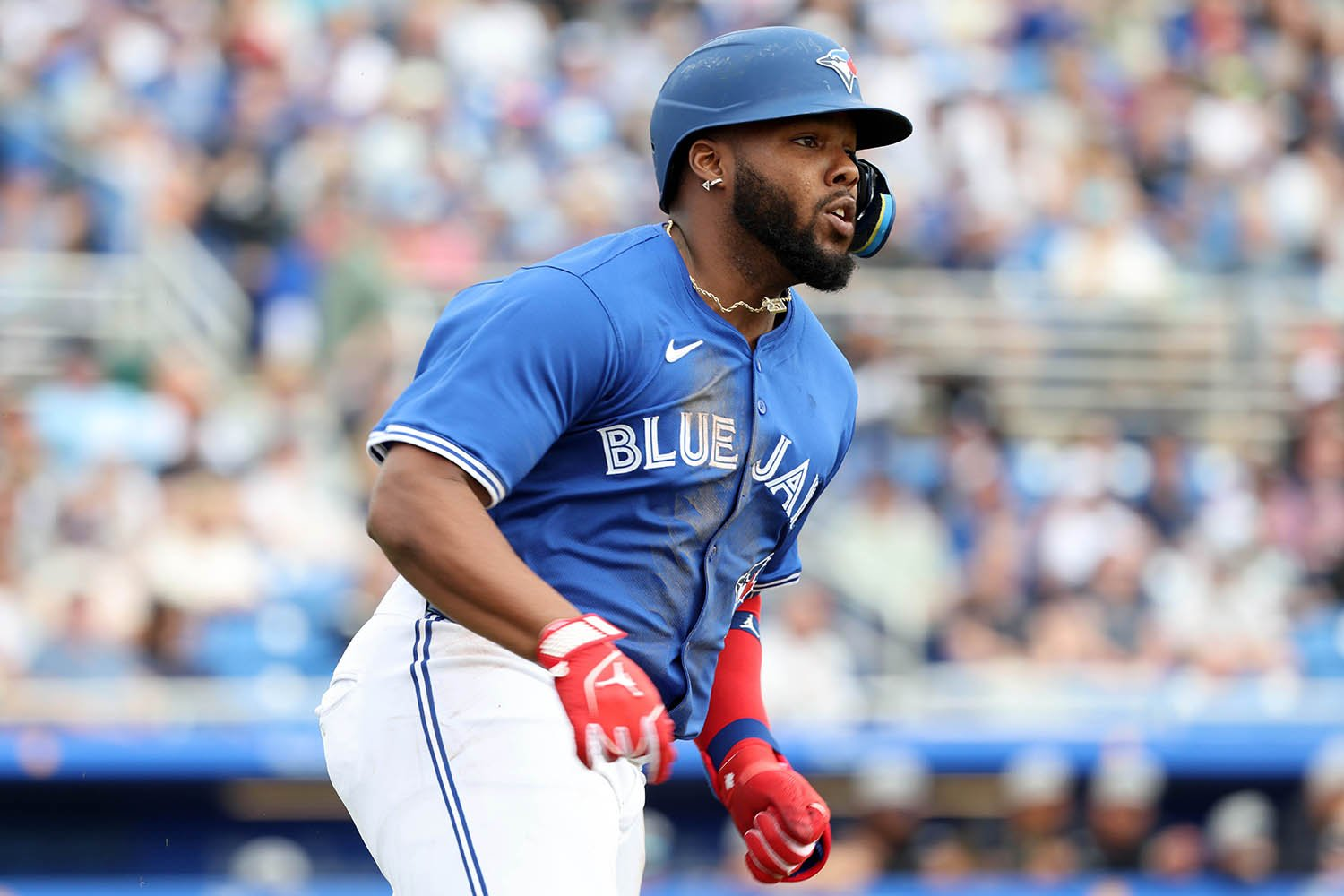

Vladimir Guerrero Jr.
Toronto Blue Jays’ star first baseman Vladimir Guerrero Jr. has reportedly turned down a contract extension valued at over $500 million.
However, according to Ken Rosenthal of The Athletic, much of that figure was tied up in deferred payments, reducing its present-day worth to somewhere between $400 million and $450 million.
While Guerrero was open to deferred money as part of a long-term deal, he insisted that the total contract value remain at the $500 million mark in real terms. The proposed deal would have put him in the same financial conversation as Shohei Ohtani’s record-setting $700 million contract with the Los Angeles Dodgers—adjusted to an approximate present-day value of $460 million.
Yet, it still would have fallen short of Juan Soto’s 15-year, $765 million deal, which contains no deferred money and could exceed $800 million if escalators are met.
Guerrero eyes lengthy commitment
Guerrero clarified early in spring training that he would not engage in contract negotiations past a self-imposed deadline, signaling his intent to test free agency following the 2025 season. The 25-year-old, who turns 26 this weekend, revealed in an interview with ESPN that he sought a deal similar in length to Soto’s but for a lower total value.
“It’s much less than Soto. We’re talking about many fewer millions than Soto—more than a hundred million less,” Guerrero stated. “It was the same number of years [as Soto’s contract] but didn’t reach $600 million. The last number we gave them as a counteroffer didn’t reach 600.”
Guerrero indicated that while adjusting his salary demands, he also shortened the years he was willing to commit. “I know the business. I lowered the salary demands slightly but also the number of years. … I’m looking for 14 [years]. I would like 14, 15, even 20 if they give them to me, but doing it the right way.”
A free agency juggernaut in the making
With contract talks now tabled, Guerrero is poised to be the marquee name in next winter’s free-agent class, sharing top billing with Chicago Cubs outfielder Kyle Tucker and San Diego Padres pitcher Dylan Cease.
However, despite his star power, Guerrero has yet to show the year-to-year consistency of other players who have landed historic deals.
By one key measure, OPS+ (for ballpark factors and era), four of Guerrero’s six MLB seasons have been below Soto’s career-worst mark of 142, recorded in his rookie campaign. Comparatively, Aaron Judge has not posted an OPS+ lower than 143 since his debut season, and even Mike Trout—who some have suggested is on the decline—had a 132 OPS+ in 2023.
Nonetheless, Guerrero’s upside remains undeniable. He possesses one of the highest offensive ceilings in baseball and will enter free agency at a premium age, which significantly boosts player value in long-term contract discussions.
Deferred money reshaping MLB’s mega deals
The increasing use of deferred money in massive MLB contracts has become a notable trend. This approach allows teams to minimize the impact on their Competitive Balance Tax (CBT) payroll, avoiding significant luxury tax penalties.
Players, in turn, often accept these structures in exchange for larger overall contract figures, sometimes offset by sizable signing bonuses.
The practice, once considered unconventional, has been refined over time. Early adopters like Bobby Bonilla and Max Scherzer helped set the precedent, but Ohtani’s groundbreaking contract—deferring a staggering 97% of his earnings—has taken the strategy to another level.
The Dodgers have been at the forefront of leveraging deferred money this offseason, but they are not alone. As long as MLB remains tolerant of the practice, more teams are expected to follow suit.
For Guerrero, rejecting Toronto’s offer signals confidence in his future market. With the Blue Jays unable to meet his long-term valuation, all signs point to an open bidding war next offseason—one that could again redefine the financial landscape of baseball contracts.