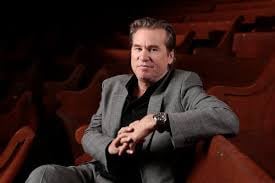

(Photos grabbed from Val Kilmer’s Facebook page).
Val Kilmer, the magnetic actor who poured his soul into every role and lived as fiercely as he performed, has died at the age of 65. A chameleon of the screen, Kilmer was a man who didn’t just play characters—he became them, vanishing behind their masks with a devotion that bordered on obsession.
He passed away Tuesday in Los Angeles from complications related to pneumonia, confirmed by his daughter, actress Mercedes Kilmer.
His death marks the end of a life as tempestuous and electrifying off-screen as it was in front of the camera—a life of artistic obsession, personal struggle, and unwavering commitment to his craft.
Diagnosed with throat cancer in 2015, Kilmer spent the last decade of his life fighting not just for survival but for his voice—literally. In Val, the intimate 2021 documentary chronicling his journey, he appeared with a breathing tube, still reaching for expression even as illness tried to silence him.
Kilmer’s legend was forged not just by fame but by fire.

Born in the heart of Hollywood in the San Fernando Valley, Kilmer was a prodigy on the stage before he became a box office idol. The youngest person ever accepted to Juilliard’s drama division at the time, he was a classically trained actor with the heart of a poet and the temperament of a storm. His roles weren’t chosen for comfort—they were battles he fought from the inside out.
He first seared into the public consciousness as the ice-cold, cocky Tom “Iceman” Kazansky in Top Gun (1986), playing opposite Tom Cruise. But the actor who stole that screen was no mere sidekick. Behind the glint of the aviator shades was an artist who would chase darker, deeper characters for the rest of his career.
And chase them he did—with a hunger.
Kilmer didn’t just portray Jim Morrison in The Doors (1991); he became him. He lived in Morrison’s skin for months, training his voice to match the Lizard King’s baritone, singing on the actual Doors master tapes so seamlessly that even band members couldn’t tell where Morrison ended and Kilmer began. “It felt less like acting and more like spiritual possession,” he once said.

Roger Ebert called the performance “a case of possession, not casting.” And that eerie commitment would become Kilmer’s signature.
In Tombstone (1993), Kilmer gave what many still consider his finest performance—as the witty, doomed Doc Holliday. Gaunt and sweat-drenched, equal parts charm and despair, he embodied a man staring death in the face with a smile and a loaded pistol. The role burned into cinematic memory not because of what he did—but because of what he was willing to feel.
Behind the scenes, Kilmer’s career was a war zone of artistic principles clashing with Hollywood politics. Directors praised his brilliance but whispered about his volatility. He famously clashed with John Frankenheimer during The Island of Dr. Moreau.
He bumped heads with Batman Forever director Joel Schumacher—despite delivering a brooding, contemplative Bruce Wayne in a film otherwise drenched in camp.
“Val worked harder than most actors to make it look believable,” said Tombstone director George Cosmatos. “He wasn’t just acting. He was sculpting the soul of his character.”
His passion came with a price. After one turn as Batman, he walked away. Not for lack of opportunity—but because the suit, the spectacle, the studio machinery—it all kept him too far from the characters he longed to explore. “Every movement was choreographed, every line scrutinized. I was playing Batman, but I couldn’t feel him,” Kilmer later revealed.
In his career, he took wild swings—sometimes for acclaim, sometimes for the thrill of the unknown. He played a haunted porn star in Wonderland (2003), a flamboyant noir detective in Kiss Kiss Bang Bang (2005), and an unhinged Brando sidekick in The Island of Dr. Moreau (1996). Even when the films faltered, Kilmer’s performances often outshined them.
His personal life, too, carried the markings of a dramatic arc. He married British actress Joanne Whalley after they met on the set of Willow (1988), a union that ended in divorce but brought him two children, including Mercedes, who would become his closest confidante and collaborator in later years.
In the end, Kilmer’s life was a testament to the strange beauty of artistic obsession. He didn’t chase fame—he chased truth. And sometimes, that pursuit took him to places few dared to follow.
“He’s in the ranks of the great American actors,” Cosmatos once said, “but he doesn’t play it safe. He never has.”
Val Kilmer didn’t want to be remembered as a movie star. He wanted to be remembered as an artist who dared to disappear into other souls. And now, as the curtain falls, we remember him not just for the roles he played—but for the man who gave everything to them.
Rest in power, Val. You were never just pretending.