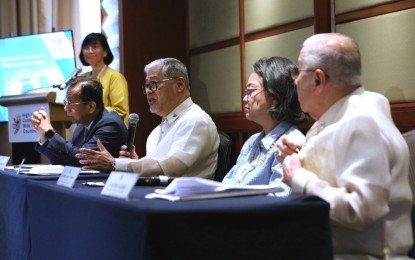

Foreign Affairs Secretary Enrique Manalo (center) speaks to the press on the sidelines of the High-Level Conference of Middle-Income Countries (HLC-MICs) hosted by the Philippine government at the Makati Shangri-La on April 29. Joining him are DEPDev Secretary Arsenio Balisacan, UNESCAP Executive Secretary Armida Salsiah Alisjahbana, and Philippine Permanent Representative to the UN in New York Ambassador Antonio Lagdameo. (PNA photo by Yancy Lim)
A bold new roadmap aimed at accelerating development in middle-income countries (MICs) was officially adopted in the Philippines on Tuesday, marking a major milestone for nations striving to overcome persistent economic hurdles.
Unveiled as the Makati Declaration, the action plan was the centerpiece outcome of the two-day High-Level Conference of Middle-Income Countries (HLC-MICs), hosted by the Philippine government from April 28 to 29 at the Makati Shangri-La Hotel.
Backed by the United Nations, the declaration lays out a strategic vision to help MICs avoid the dreaded “middle-income trap” — a cycle where economic growth stalls before reaching high-income status. It also pushes for a more inclusive, climate-resilient, and digitally connected future.
A new development blueprint
The Makati Declaration highlights several urgent priorities:
- Rethinking development metrics beyond traditional GDP
- Ensuring debt sustainability
- Boosting financing for development
- Tackling climate change, accelerating digital transformation, and promoting gender equality and social protection
Crucially, it calls for MICs to play a stronger role in shaping the global development agenda through active participation in United Nations platforms.
Despite notable economic growth in recent years, many MICs—including the Philippines—continue to grapple with inequality, joblessness, and the mounting threat of climate change.
“The journey forward must include recognizing and addressing the unique needs of MICs within the UN system,” said Foreign Affairs Secretary Enrique Manalo during a press briefing. “This Strategic Program of Action is meant to attract more targeted support from the international community.”
A stronger voice through unity
Arsenio Balisacan, Secretary of the Department of Economy, Planning, and Development, emphasized the power of collective action. He noted that the declaration signals a renewed commitment to multilateralism.
“We’re giving multilateralism a new breath. Acting as one, MICs can better push for improved access to trade, finance, and technology on the global stage,” Balisacan said.
Continued UN commitment
The United Nations reaffirmed its long-term support for MICs. Armida Salsiah Alisjahbana, UN Under-Secretary-General and Executive Secretary of ESCAP, stressed the importance of continuing financial cooperation and development support.
Even as the Philippines edges closer to upper-middle-income status, the UN’s engagement will adapt, not fade, said Haoliang Xu, UNDP Associate Administrator.
“Our support must evolve with the country’s needs,” Xu explained. “While the Philippines is progressing, inequality still exists — especially in regions like Bangsamoro. We need to focus on where we can add the most value.”
Xu highlighted promising signs for the country’s future: low public debt, a clear national vision, and a strong focus on public-private partnerships. “These are strong indicators that the Philippines is on the right track,” he added.
A global gathering for a common cause
The HLC-MIC drew more than 200 delegates from over 24 nations, including ministers, senior officials, and key representatives from the United Nations.
The event was organized under the Like-Minded Group of Middle-Income Countries (LMG-MICs), currently chaired by the Kingdom of Morocco. Member states include nations from Latin America, Asia, and Africa such as Colombia, Mexico, Namibia, the Philippines, and Uruguay.
Other participating countries included Bangladesh, Fiji, Indonesia, Malaysia, Mongolia, and Thailand, showing a wide commitment to transforming the role of MICs in the global development landscape.