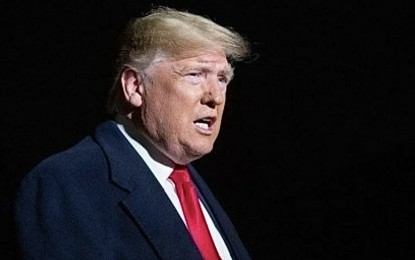

WASHINGTON – US President Donald Trump signed an executive order Wednesday delivering on his long-promised vow to impose reciprocal tariffs on nations worldwide in a move that has sent markets sharply lower for months.
A minimum baseline tariff of 10 percent will be imposed on all countries except Canada and Mexico, with higher sums charged on nations that Trump has deemed the “worst” trade offenders.
The president said his new economic effort seeks to “help build our economy” by spurring domestic manufacturing, raising government revenue, and thwarting what he called “cheating” on trade.
“This is one of the most important days, in my opinion, in American history. It’s our declaration of economic independence,” he said in remarks delivered from the Rose Garden.
“We will supercharge our domestic industrial base. We will pry open foreign markets and break down foreign trade barriers, and ultimately, more production at home will mean stronger competition and lower prices for consumers,” he added.
A series of handouts that the White House circulated among reporters highlights some of the reciprocal tariffs being imposed by the president, including a 34 percent tariff on goods imported from China, a 20 percent tariff on European Union goods, a 46 percent tariff on Vietnamese goods, and a 44 percent tariff on Sri Lankan imports.
About 60 nations will face tariffs above 10 percent, according to a White House official who briefed reporters on condition of anonymity ahead of the official rollout.
Türkiye is among the nations that will face a 10 percent tariff alongside the UK, Kenya, Iceland, Panama, Ethiopia, Lebanon, Togo, and others.
Canada and Mexico will not be subject to the new tariff regime after facing previous penalties imposed by Trump to pressure them to take greater action on migration and the flow of illicit fentanyl across the US border.
The official said that in the event that the existing tariffs are “terminated or suspended, based on their conduct, they will default to this other regime.”
Markets had sunk significantly since February when Trump first announced his intention to implement his reciprocal tariff plan, driven by concerns that the policy would drive up consumer pricing across a wide swathe of goods and possibly throw the US into a recession.
The downward spiral in markets continued in the minutes after his announcement with futures plummeting. Futures for the tech-heavy Nasdaq were down more than 2.3 percent while the S&P 500 slid more than 1.5 percent. (Anadolu)

