
Cyberthreats, with their increasing frequency and sophistication, pose a heavy toll on the Philippines’ financial security and personal stability of Filipinos. But stakeholders are fighting back, demanding strengthened regulatory intervention from the government.
Indeed, a study commissioned by the Motion Picture Association (MPA) and authored by Dr. Paul Watters of Macquarie University found that Filipinos are up to 33 times more likely to encounter cyber threats on popular pirate websites than on legitimate film and TV platforms.
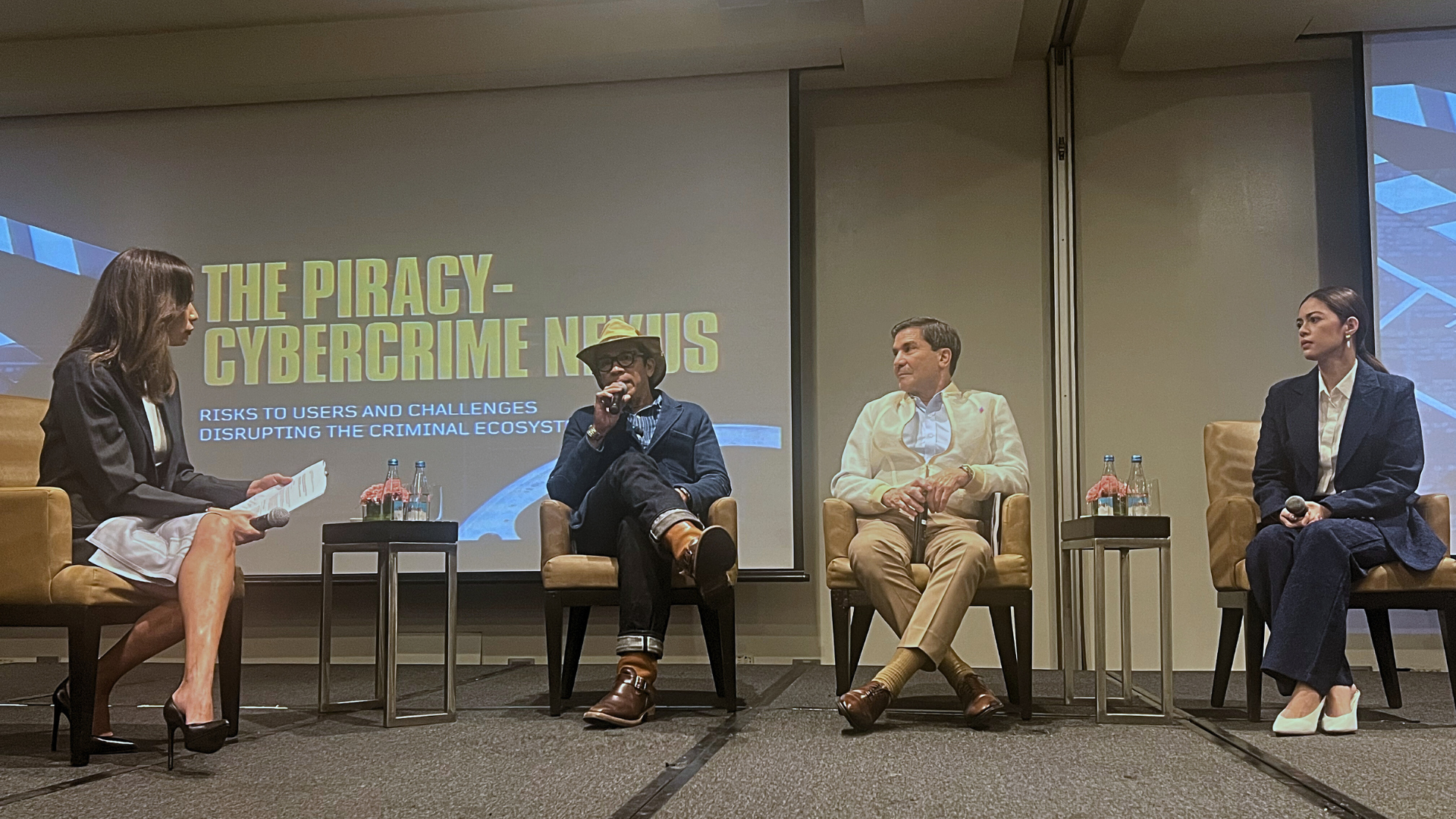
In an anti-piracy symposium organized by the Intellectual Property Office of the Philippines (IPOPHL), the Alliance for Creativity and Entertainment (ACE), GMA Networks, Inc., and Globe, several panel discussions have focused on the extreme losses from cyberattacks, leaving the movies and entertainment industries uniquely exposed to cyber threats as operations involve vast amounts of sensitive data and transactions.
Watters cited how high internet and mobile data usage in the Philippines makes Filipinos an attractive target for pirates. He said pirate sites provide a platform for criminals to harvest customer data more efficiently than hacking into websites to get data. Unfortunately, consumers in the Philippines use pirate sites unaware of their inherent dangers, including exposing their data.
With such consumer vulnerabilities, Watters underscored the need to implement measures to ensure compliance and build awareness of the threats lurking in pirate sites.
“Site-blocking of the most popular pirate sites is the most effective baseline option,” he said in a fireside chat.
Yoly Crisanto, Globe’s Chief Sustainability and Corporate Communications Officer, cited the urgency for Congress to amend the Philippines’ outdated Intellectual Property Code to strengthen enforcement against content piracy, particularly authorizing site-blocking. All progress on amending bills will be lost once the current congressional ends and new leaders take office after the 2025 elections.
“At Globe, we champion a digital world that is safe and empowering for all Filipinos. This study underscores how critical it is to pass legislation that would authorize site blocking to protect consumers, especially our youth, from the hidden dangers lurking on pirate sites,” said Crisanto.
“We urge Congress to pass this vital piece of legislation before the end of their session to avoid further delays and safeguard the digital well-being of our nation,” she added.
Stars weigh in
Some of the country’s biggest celebrities rallied behind the call for stronger enforcement against content piracy.
In a fireside chat moderated by TV host Pia Guanio, her fellow Team Globe of Good Ambassadors Edu Manzano, Shaina Magdayao, and Kim Atienza talked about how piracy has effectively crippled the entertainment industry.
Manzano, actor and former head of the Optical Media Board, recalled when the Philippine film industry produced over 200 films yearly. Because of piracy, this number is down to less than 30 per year, leaving many industry workers out of jobs.
“It was a tough time because we could not find work for over 9,000 unemployed workers in our industry. We saw the direct effect. Sad to say people show up in the office to ask for a buck or two,” said Manzano, recalling the toll of piracy when the crime first emerged.
“To this day, I have to say that the industry has not recovered,” said Manzano.
He cited the urgency of passing legislation with strong penal provisions to clamp down on piracy, noting that this crime is borderless.
“Right now, with how it’s going, I feel that we need legislation. We have to pressure like-minded members of the House of Representatives and the Senate and let them realize that laws become flawed soon after they pass because technology advances at an amazing pace,” Manzano said.
Meanwhile, Magdayao, among the most prominent actresses of her generation, said piracy has discouraged investments in the entertainment industry, limiting the great potential of Filipino creatives.
“At the end of the day, to be honest, as a worker myself, show business is a “business.” If walang ROI ang producers and investors because people are not willing to go to the cinemas anymore or pay legit streaming channels, producers won’t be investing in our talent and work anymore or even funds to train, educate and hone the talents of emerging filmmakers in the country,” Magdayao said.
““Lagi ko rin niyayabang sa foreign producers whenever I attend International festivals na maganda ang Pilipinas. We have beautiful locations, people, and talents ….. but how will we, as talents and as an industry, grow and expand if no one invests? Piracy limits Filipinos from reaching global cinema na kayang-kaya naman sana natin, given the proper opportunity, help and support,” she said.
Globe has consistently advocated for a safer and more responsible digital space. As a proud member of the AVIA-CAP and the Video Coalition of the Philippines, Globe actively supports legislative efforts to curb online piracy, such as the pending Senate bills aimed at strengthening site-blocking provisions within the Intellectual Property Code.
Globe believes the creative industry must be more stringently protected to ensure a sustainable future for content creators and consumers. Its long-going #PlayItRight campaign raises public awareness of the perils of content piracy and advocates for more robust protection of the country’s P1.6-billion industry.
Learn more about #PlayItRight via this page.