
The solarization of government buildings continues to gain ground nationwide, with four more local government units (LGUs) formalizing their partnerships with the Department of Energy (DOE) today, bringing to 38 the number of LGUs committed to adopting solar energy and energy efficiency measures in public facilities.
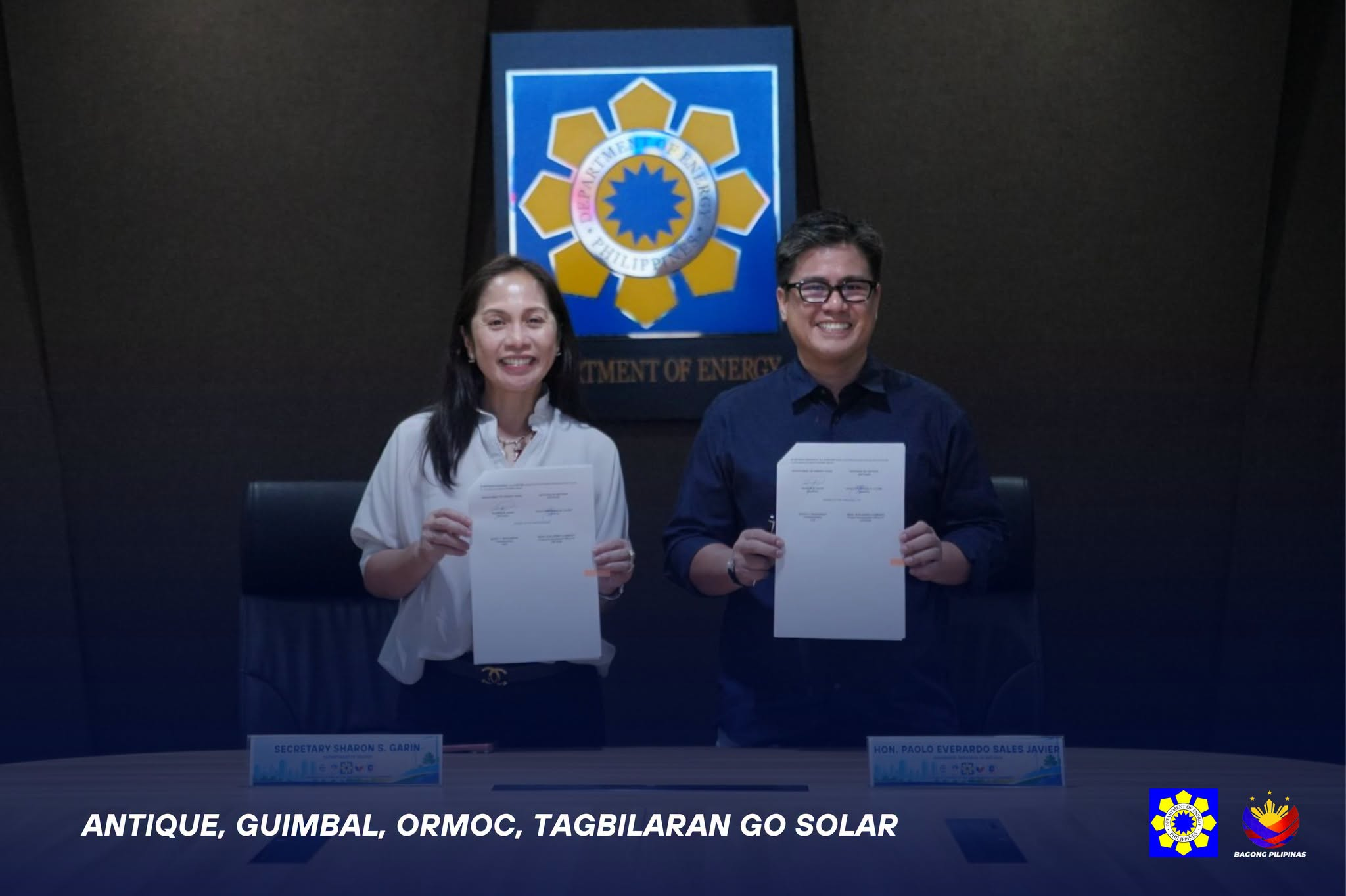
Energy Secretary Sharon S. Garin led the ceremonial signing of Memoranda of Agreement (MOAs) at the DOE headquarters in Bonifacio Global City, Taguig, with the Province of Antique, the Municipality of Guimbal in Iloilo, Ormoc City, and Tagbilaran City under the Solar Solutions for Government: Energy Efficiency and Renewable Energy in Public Buildings (SSG–ERPB) initiative.
Signing the agreements on behalf of their respective LGUs were Antique Governor Paolo Everardo Sales Javier, Guimbal Mayor Jennifer Garin Colada, Ormoc City Mayor Lucy Torres, and Tagbilaran City Mayor Jane Censoria Cajes-Yap.
Through the initiative, participating LGUs can transform underutilized rooftops of provincial capitols, municipal and city halls, health centers, and schools into power-generating assets that help meet the electricity requirements of public facilities.
Under the partnership framework, the DOE will provide free technical assistance, preliminary assessments, and implementation guidance to participating LGUs to facilitate the deployment of solar photovoltaic (PV) systems complemented by energy efficiency measures suited to the operational requirements of their facilities.
Secretary Garin emphasized that reducing electricity expenses in government operations can free up public resources for essential services that directly benefit communities.
“The funds you free up can go where your constituents feel them most: medicines for the barangay health station, repairs for a classroom, assistance for a family in need. Every peso saved on electricity is a peso returned to the people,” Secretary Garin said.
The initiative is particularly timely amid the impacts of a very strong El Niño, which, according to the Philippine Atmospheric, Geophysical and Astronomical Services Administration (PAGASA), is expected to persist through the first half of 2027. Prolonged dry spells and higher temperatures could increase cooling demand and strain power supply, particularly in the Visayas. By generating electricity during periods of high daytime demand, rooftop solar systems can help ease pressure on the grid and support the continued delivery of public services.
The initiative supports the implementation of Republic Act No. 11285, or the Energy Efficiency and Conservation Act, and the Government Energy Management Program (GEMP), which seeks to achieve at least 10 percent energy savings in government operations. It also contributes to the country’s targets of increasing the renewable energy share in the power generation mix to 35 percent by 2030 and 50 percent by 2040.
The program also extends to national government agencies, with the DOE partnering with the Department of Health to advance renewable energy and energy efficiency in public healthcare facilities.
Following the signing ceremony, Secretary Garin accompanied the local government officials and Representative Richard Gomez on a tour of the DOE Energy Museum, which serves as an educational platform showcasing the evolution of the Philippine energy sector, the country’s diverse energy resources, and the role of emerging technologies in shaping a sustainable energy future. The visit provided an opportunity to deepen appreciation of the importance of renewable energy, energy efficiency, and responsible energy use in advancing national development.
“What begins on your rooftops today can become the model for LGUs across the country. The energy transition is built facility by facility, community by community, and you have taken the first step,” Secretary Garin said.