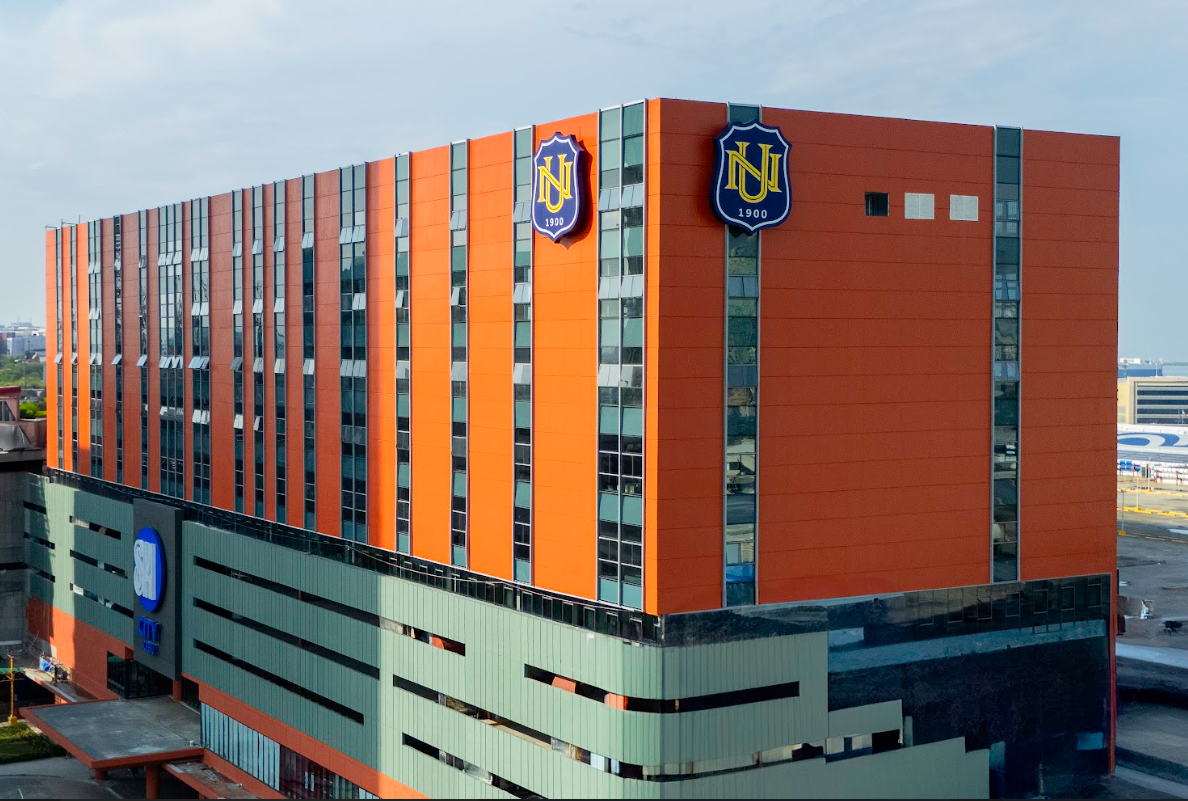

NU Cebu
By bringing higher education closer to home, the SM Group is quietly reshaping the country’s talent landscape—proving that opportunity no longer has to mean leaving one’s hometown.
“We bring talent back to the provinces,” said NU President and CEO Dr. Renato Carlos Ermita. “NU offers a standardized salary matrix applicable to all our employees across the country. This approach has helped NU make our recruitment more appealing to applicants in provincial regions.”
National University (NU), part of the SM education ecosystem, now serves more than 84,000 students across seven campuses outside Metro Manila, expanding not just access to quality education but also professional careers in the regions.
From Bacolod and Cebu to Clark, Laguna, and Batangas, NU’s growing provincial footprint is helping reverse the long-standing pattern of brain drain by creating viable academic and employment pathways where Filipinos already live.
The impact is measurable. NU Bacolod, the university’s first Visayas campus, employs 96 percent local staff, with only a handful transferring from other campuses.

NU President and CEO Dr. Renato Carlos Ermita
NU Laguna reports 99 percent local hires, NU Baliwag 98 percent, NU Dasmarinas 96 percent, NU Lipa 98 percent, and NU Clark 97 percent. NU Cebu, which opened this academic year, stands out with a workforce made up entirely of local hires.
For NU, regional expansion is not just about geography but about equity. By maintaining a standardized compensation package across all campuses nationwide, the university has made provincial postings more attractive to educators and professionals who would otherwise feel compelled to move to Metro Manila or abroad.
That strategy directly addresses the widening gap between urban and rural areas, where access to quality education and stable employment often determines long-term economic outcomes.
By aligning education with local labor and development needs, NU strengthens regional ecosystems and allows communities to retain their own talent.
NU’s integration into SM’s mall-based communities further reinforces this vision of responsible development. Most NU campuses are located within or near SM properties, making education more accessible and affordable while ensuring safety and convenience for students and employees alike.
“NU is part of SM’s corporate social responsibility,” Dr. Ermita said. “By allowing the campus to be a part of the SM community, accessibility is achieved and affordability is maintained. Transportation hubs are also located near most of the mall-based campuses, allowing safety and convenience for the students and employees.”
Nowhere is this more personal than in NU Cebu. Executive Director Johanna Minglana is among the returnees who found their way back home through the university’s expansion. A Cebu native who spent decades growing up and building her career in Manila, Minglana said NU Cebu allowed her to come full circle.
“NU Cebu gave me the opportunity to return to my birthplace after decades of growing up in Manila while continuing my academic career,” she shared. Three members of the leadership team, including Minglana, are returnees from NU Manila who relocated when the Cebu campus opened.
Her experience mirrors that of many faculty and staff. Working at NU Cebu, she said, has allowed them to pursue meaningful careers without leaving their families or communities behind, fostering a deeper sense of purpose rooted in service and nation-building.
“These stories are not isolated,” Minglana said. “They reflect the broader impact of NU Cebu’s commitment to regional development and talent retention.”
Beyond the classroom, NU’s presence has ripple effects across host communities. Minglana noted that campuses stimulate local economies by generating jobs not only within the university but also in nearby food establishments, boarding houses, transport services, and retail outlets. Students, faculty, and employees contribute daily to economic activity in environments designed to be fun, safe, and secure.
As National University recently marked its 125th founding anniversary—its quasquicentennial year—thousands of alumni gathered at SM Mall of Asia Sky, a testament to the institution’s enduring reach. Looking ahead, NU aims to continue delivering world-class, life-ready education that equips graduates to compete anywhere, whether they choose to build their futures in the provinces or beyond.
In doing so, NU and the SM Group are redefining success—not as a one-way journey to the capital, but as an opportunity to thrive, give back, and build communities where home truly matters.