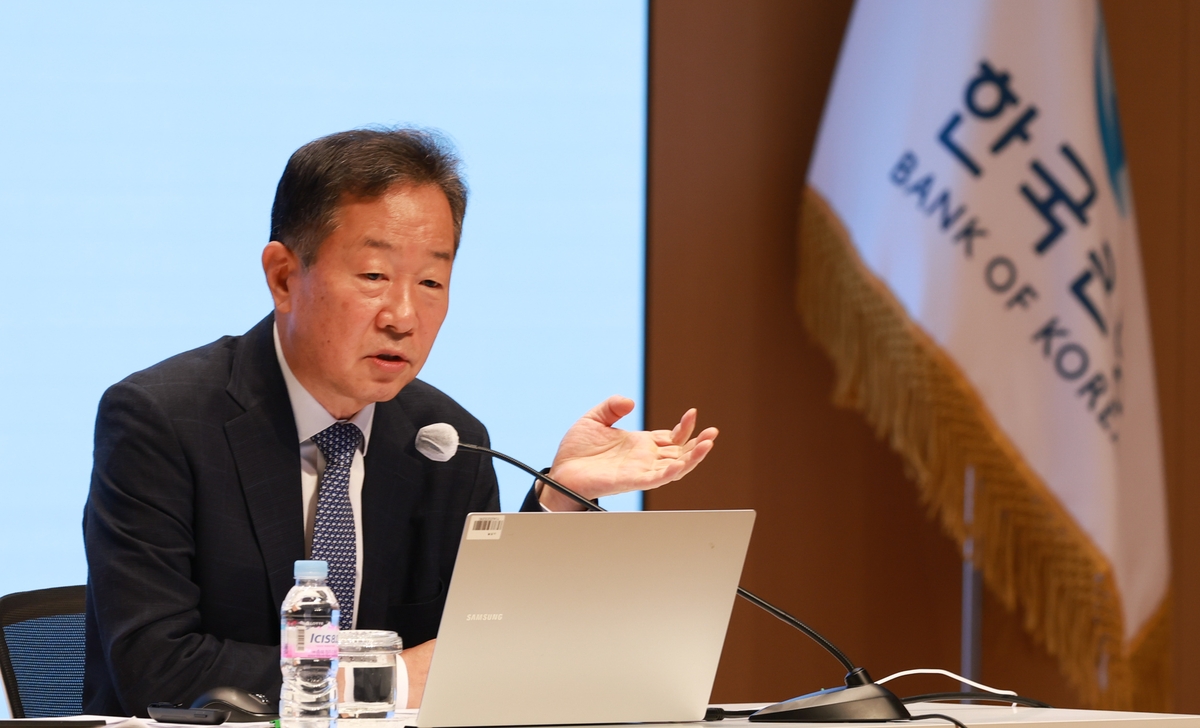
A foreign exchange swap between South Korea and the United States would be desirable as a safety net, though such an agreement would be a sensitive and highly political matter, a member of South Korea’s central bank monetary policy board said Tuesday.
Hwang Kul-il, a member of the Bank of Korea’s (BOK) monetary policy board, made the remarks during a meeting with reporters in Seoul, as the Seoul government has proposed a foreign exchange swap line with the U.S. in recent tariff talks with Washington.
“The more currency swaps you have, the better. They serve as a safety net, so it’s good to have them,” Hwang said.
“But a currency swap is a sensitive area and a type of negotiation. I personally see this not as an economic issue, but as a highly political one. That is why it has to be handled in secret, and we cannot discuss the matter publicly,” he added.
In July, the two nations reached a deal in which the U.S. would impose a 15 percent tariff on South Korean goods, rather than the initially threatened 25 percent, while Seoul would create a US$350 billion fund for U.S. investments.
The two sides, however, remain in deadlock over the details, and no formal agreement has yet been finalized.
In a recent press interview, President Lee Jae Myung warned that the Korean economy could face a crisis comparable to the 1997 financial meltdown if his government accepts current U.S. demands without safeguards.
South Korea previously established temporary currency swap lines with the U.S. during the 2008 global financial crisis and the 2020 COVID-19 pandemic, with limits of $30 billion and $60 billion, respectively, and their effects “were actually very significant,” Hwang added.
Asked about the need to expand the nation’s foreign exchange reserves, Hwang expressed support for greater reserves but cautioned that buying dollars or issuing foreign exchange-linked bonds could directly affect the exchange rate and should be carefully managed.