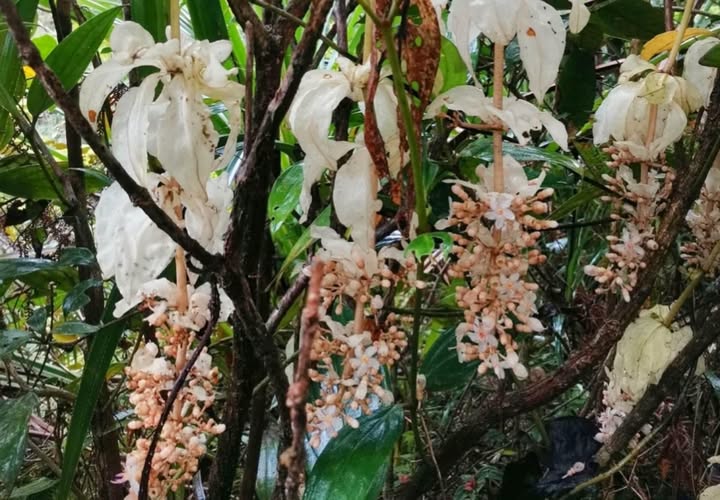

(Photo courtesy of Apayao Province)
BAGUIO CITY – Researchers have identified another plant species previously unknown to science in Apayao, underscoring the rich biodiversity and scientific significance of the province’s UNESCO Biosphere Reserve.
The discovery came more than two years after the United Nations Educational, Scientific and Cultural Organization (UNESCO) designated Apayao as a biosphere reserve in July 2024.
Apayao Governor Elias Bulut Jr. welcomed the latest scientific breakthrough, highlighting the province’s potential as a center for biodiversity research and environmental conservation.
“We are glad we had it declared as a biosphere reserve, which can serve as a classroom for our scientists and a rich resource for researchers to discover previously undocumented plant and animal species,” Bulut said in a phone interview Tuesday.
The governor said the latest discovery brought to three the number of newly described plant species in the municipality of Calanasan since 2025.
According to the provincial government, the newly identified species, Medinilla bulutiorum, was documented in Eva Puzon and formally described in the international scientific journal Phytotaxa on November 18, 2026.
The study was conducted by Jiro Adorador, Zhereeleen Meneses-Adorador, Breiden Dela Cruz, Sarah Mae Batil, Jayson Ibañez, and J. Peter Quakenbush.
The discovery followed the identification of Vaccinium kilangensis, a relative of the blueberry, which was collected from Kilang Pass in Barangay Butao, Calanasan, near the Apayao-Ilocos Norte boundary and formally described in October 2025.
In February 2026, researchers also published their findings on Medinilla calanasan, another plant species initially discovered in Barangay Eva.
“The succession of discoveries shows that Calanasan continues to provide valuable records for botanical research and adds to the scientific importance of the Apayao Biosphere Reserve,” the provincial government said.
Researchers noted that Medinilla bulutiorum, despite being common in the area where it was discovered, had escaped scientific documentation for more than a century.
The species shares similarities with Medinilla magnifica but possesses distinct characteristics, including differences in its branchlets, smaller leaves, flower clusters, and brown covering on portions of its inflorescence.
It was named in honor of the Bulut family, particularly the late Elias Bulut Sr., popularly known as “EKB” and regarded as Apayao’s founding father, in recognition of the family’s leadership and stewardship of ancestral lands.
The species has been preliminarily classified as data deficient due to insufficient information regarding its population and geographic distribution to determine its risk of extinction.
Strengthening research and conservation efforts
Bulut said the provincial government had begun training residents as local guides to assist scientists and researchers exploring Apayao’s dense and relatively untouched forests, considered the last frontier of the Cordillera Administrative Region.
“We need guides because the forest is thick and relatively untouched. It is important to ensure safety by having local guides assist researchers as they conduct their studies in our province,” he said.
The provincial government also established a library-museum in Calanasan to serve as an additional resource for scientific studies and biodiversity documentation.
Local communities are likewise being prepared to accommodate Filipino and international researchers through lodging facilities and other support services.
“We hope these activities, which have minimal to zero impact on the environment, will provide our people with additional livelihood opportunities in their own homes and communities. They can also prepare and serve home-cooked meals for researchers, giving them an additional source of income,” Bulut said.
The governor emphasized that Apayao residents have long played a vital role in protecting the province’s forests, noting that sustainable livelihood opportunities are essential to maintaining community participation in conservation efforts.
He said the province aims to strike a balance between environmental protection, scientific advancement, and economic opportunities, ensuring that local communities directly benefit from preserving Apayao’s natural resources.