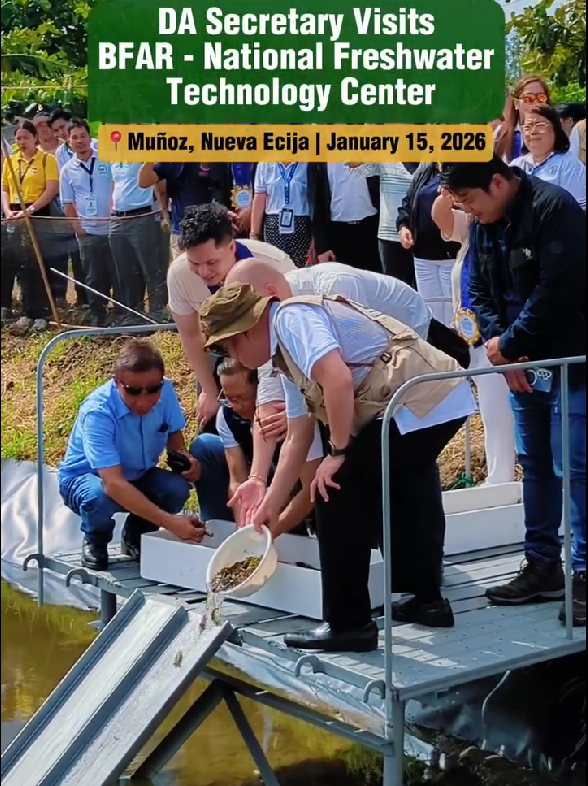

(Screengrab : BFAR Philippines video fbpage)
CABANATUAN CITY — The Department of Agriculture has kicked off a pilot program to evaluate the commercial potential of Australian redclaw crayfish in Nueva Ecija, marking a strategic move to diversify rural livelihoods and raise incomes through higher-value aquaculture.
The initiative aligns with the directive of Ferdinand R. Marcos Jr. to strengthen the country’s aquaculture sector by expanding beyond traditional, volume-driven production. On January 15, Agriculture Secretary Francisco Tiu Laurel Jr. led the ceremonial stocking of 14,000 craylings in the Science City of Muñoz, formally launching an on-farm verification trial.
The trial will assess whether redclaw crayfish can be profitably cultured in Philippine freshwater ponds under local conditions. Laurel said the project reflects the DA’s push to help farmers transition toward enterprises with stronger market value, provided they adhere to good aquaculture practices and strict biosecurity protocols.
He added that redclaw crayfish culture could offer farmers an additional income stream alongside traditional crops, while promoting a more sustainable and disciplined approach to fish farming.
The program is being implemented by the DA through the Bureau of Fisheries and Aquatic Resources (BFAR) in partnership with private-sector stakeholders, underscoring a shift toward science-based and market-oriented aquaculture development rather than unchecked expansion.
To safeguard ecosystems, BFAR issued Administrative Circular No. 001, series of 2025, establishing the country’s first national guidelines for culturing Australian redclaw crayfish. The rules require that broodstock and craylings be sourced only from certified local hatcheries or BFAR facilities to manage biosecurity risks and prevent environmental harm.
BFAR has anchored the initiative at its prototype hatchery at the National Freshwater Fisheries Technology Center, where an initial core stock of 30 female and 10 male breeders is maintained. The facility also houses around 200 prospective breeders capable of producing up to 5,000 craylings per cycle across three to five cycles annually, with an additional 300 craylings reserved for controlled tank-based trials.
Field validation in Nueva Ecija will run for four to five months across four ponds. Technicians will test stocking densities of 10 and 15 crayfish per square meter while closely monitoring survival rates, growth performance, feed efficiency, and overall economic returns to determine commercial viability.
Should results prove favorable, BFAR plans to scale up the initiative through full technology demonstrations, standardized training protocols for farmers, and possible expansion to suitable inland areas nationwide.
By combining careful trials, tighter biosecurity controls, and collaboration with the private sector, the DA aims to balance opportunity and risk as it explores redclaw crayfish as a premium aquaculture commodity—one that could help reshape fish farming while delivering long-term, sustainable gains for Filipino farmers and fishers.