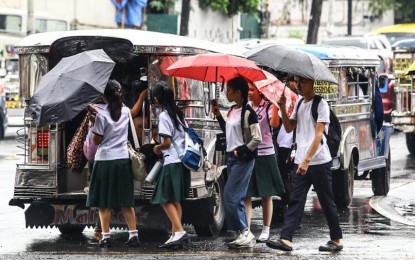

Students board a public utility jeepney in Cubao, Quezon City after classes were suspended due to inclement weather caused by the southwest monsoon earlier this month. The city government on Thursday (July 10, 2025) announced that it has institutionalized blended learning to ensure continuous learning amid class disruptions. (PNA photo by Joan Bondoc)
The Quezon City government has formally adopted a blended learning system in all its public elementary and high schools, aiming to ensure uninterrupted education despite challenges such as classroom congestion and weather-related disruptions.
Mayor Joy Belmonte signed Ordinance SP-3405, S-2025, which institutionalizes blended and flexible learning in the city’s public education system. The move supports the Department of Education’s (DepEd) national flexible learning policy and transforms it into a structured local initiative.
“Face-to-face classes remain the core of our public school system, but now, when students can’t physically attend, we have a reliable alternative,” Belmonte said in a statement.
Under the ordinance, schools can transition to blended or flexible learning modes during emergencies, such as typhoons, intense heat, or when classroom space becomes insufficient. The ordinance also ensures that the local government allocates funding and planning support to sustain these programs.
To make the system effective, the city is ramping up investments in digital infrastructure, teacher training, and public awareness campaigns. Belmonte noted that part of the plan includes converting underused community areas into neighborhood learning hubs equipped with Wi-Fi and educational resources, giving students safe spaces to study even outside school.
“We’re committed to making sure education continues, regardless of the circumstances—be it natural calamities, heatwaves, or the ongoing problem of overcrowded classrooms,” she said.