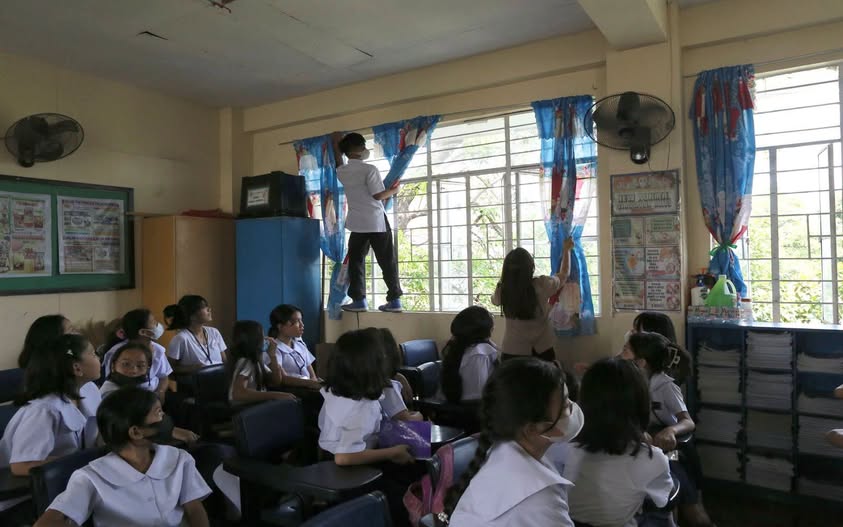

(Photo courtesy of PNA)
MANILA – The Quezon City government has revoked its previous policy on heat-related class suspensions to comply with new Department of Education (DepEd) guidelines allowing school heads to determine appropriate learning arrangements during extreme weather conditions.
In a statement issued Tuesday evening, the city government announced the withdrawal of Memorandum Circular No. 3, series of 2025, as part of its efforts to align local policies with the national government’s updated framework for class suspensions.
The revoked circular, issued in March 2025, established guidelines for suspending classes in public and private schools, child development centers and other educational institutions during tropical cyclones, heavy rainfall, extreme heat, earthquakes and poor air quality.
It provided automatic suspension mechanisms based on weather advisories from the Philippine Atmospheric, Geophysical and Astronomical Services Administration (PAGASA), including rainfall warnings, heat-index levels, earthquake intensity and air quality conditions.
The policy also authorized the Quezon City Disaster Risk Reduction and Management Council and school authorities to implement localized class suspensions when weather or environmental conditions threatened the safety of students and school personnel.
Schools were likewise required to adopt alternative learning arrangements to ensure the continuity of education during suspensions.
New national framework for class suspensions
The policy adjustment follows Executive Order No. 130, signed by President Ferdinand Marcos Jr. on October 28, establishing a unified system for suspending and resuming in-person classes nationwide.
The executive order introduces three mechanisms for determining class suspensions: automatic suspension and resumption based on established hazard thresholds, localized decisions by local chief executives, and school-specific adjustments by educational institutions and learning centers.
The framework aims to ensure that decisions are based on official hazard warnings, local risk assessments and actual conditions affecting individual schools.
Meanwhile, DepEd Memorandum No. 064, series of 2026, issued on October 26, directed schools to prepare for extreme heat, water shortages and other possible effects of the anticipated very strong El Niño phenomenon.
The directive introduced the 4H Framework, consisting of Hayo, Hinay, Hinga and Hinto, to guide schools in responding to heat-related risks.
“The City Government will also comply with Executive Order No. 130 and awaits its implementing guidelines to ensure proper implementation,” the Quezon City government said.
School heads authorized to adjust learning arrangements
Under the updated DepEd guidelines, public school heads are tasked with evaluating conditions within their respective campuses to determine whether adjustments to class schedules or learning arrangements are necessary.
Depending on the severity of heat conditions, school administrators may modify class hours, suspend face-to-face classes or shift to alternative learning delivery modes.
Such decisions must be coordinated with the Schools Division Office to ensure that student safety and learning continuity remain priorities.
Private educational institutions are also encouraged to adopt the guidelines when applicable.
The revised approach allows schools to respond to actual conditions on their campuses rather than relying solely on citywide heat-index readings.
The Quezon City government advised parents, guardians and students to regularly check official school communication channels for announcements regarding class schedules, suspensions and alternative learning arrangements.
Local officials emphasized the importance of following verified school advisories to avoid confusion and ensure that learners and school personnel remain protected during periods of extreme heat.