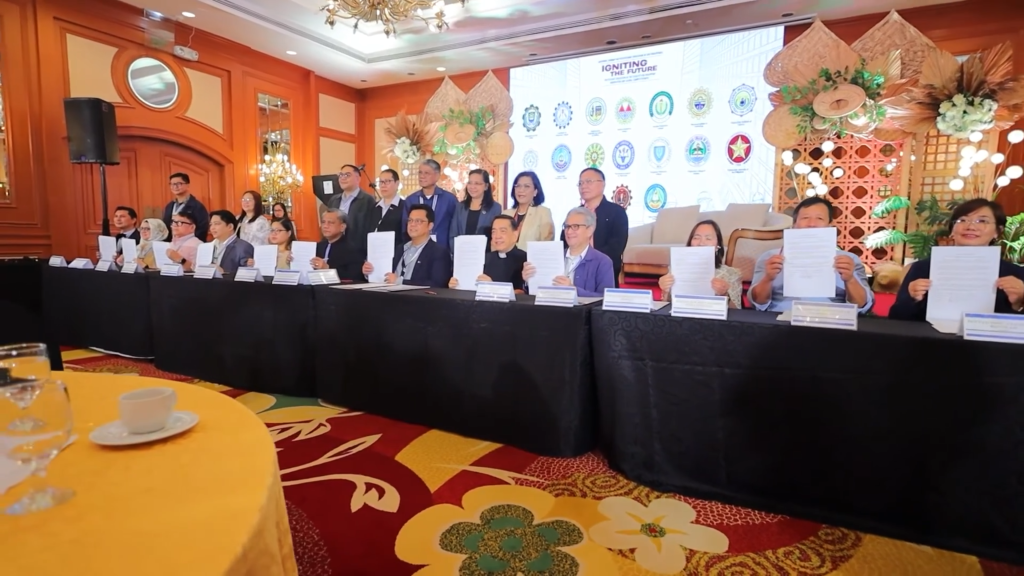

(Photo courtesy of PIA)
PASAY CITY – Higher education institutions (HEIs) across the Philippines have formalized a partnership to strengthen polytechnic education through the establishment of the Philippine Polytechnic Education Network (PhilPEN) and the development of a national framework for 2027 to 2030.
The initiative was launched during the National Summit on Polytechnic Education in the Philippines, organized by the Polytechnic University of the Philippines (PUP) from October 14 to 16 at the Heritage Hotel in Pasay City.
Participating institutions signed a Pledge of Commitment and Framework Agreement on October 15, establishing a voluntary network aimed at promoting cooperation in academic programs, research, quality assurance, and resource sharing.
Under the agreement, member institutions will retain their autonomy while pursuing joint initiatives through separate institutional arrangements.
PUP President Manuel Muhi called on participating schools to translate the summit’s discussions into concrete programs that would strengthen the country’s polytechnic education system.
“Let’s work together as one polytechnic,” Muhi said.
“Let us build a consortium that will advance polytechnic education, that will contribute to national progress while responding to global challenges,” he added.
Commission on Higher Education (CHED) Chairperson Shirley Agrupis expressed support for the initiative, emphasizing the importance of expanding credit transfer systems, recognizing prior learning, and strengthening faculty development.
Agrupis said recognizing skills and competencies acquired outside traditional classrooms would help educational institutions respond to changing economic and workforce demands.
“Establishing a recognition of prior learning system is very critical in order to respond to the various needs of individuals, and also the changing needs according to the changes of the economy and societies,” she said.
She also underscored the need to create more accessible learning pathways for Filipino students.
“And the goal is very clear: to make a seamless pathway for every single Filipino learner. We can always bridge the gap,” Agrupis added.
The CHED chief stressed that improving polytechnic education also requires sustained investment in qualified and competent educators.
During the summit’s closing session on October 16, PUP University Legal Counsel and Drafting Committee Lead Joanna Marie Liao presented the Philippine Polytechnic Education Framework for 2027 to 2030.
The roadmap outlines six strategic objectives, including the registration of PhilPEN with the Securities and Exchange Commission, curriculum alignment with the ASEAN Polytechnic Education Framework, stronger connections between technical-vocational training and higher education, and the sharing of laboratories and faculty resources.
“Individually we are strong, but together, we are an unstoppable force for national development,” Liao said.
She described PhilPEN as a long-term commitment among educational institutions to advance polytechnic education and contribute to national development.
Meanwhile, PUP Vice President for Academic Affairs Emanuel De Guzman emphasized that technical competence must be accompanied by ethical responsibility and a commitment to public service.
“In a country where corruption continues to undermine our institutions and the public good, technical excellence without moral responsibility is never enough,” De Guzman said.
He added that the success of polytechnic education should not be measured solely by graduate employment and economic contributions, but also by its ability to improve institutions, uphold human dignity, and promote social development.
The summit, guided by the ASEAN 2026 theme “Navigating Our Future, Together,” highlighted the importance of collaboration among higher education institutions in building a more responsive, inclusive, and globally competitive polytechnic education system.