
(Photo courtesy of PSEi Facebook)
Philippine stocks and the peso closed lower on Friday as weak global market sentiment and disappointing domestic economic data weighed on investor confidence.
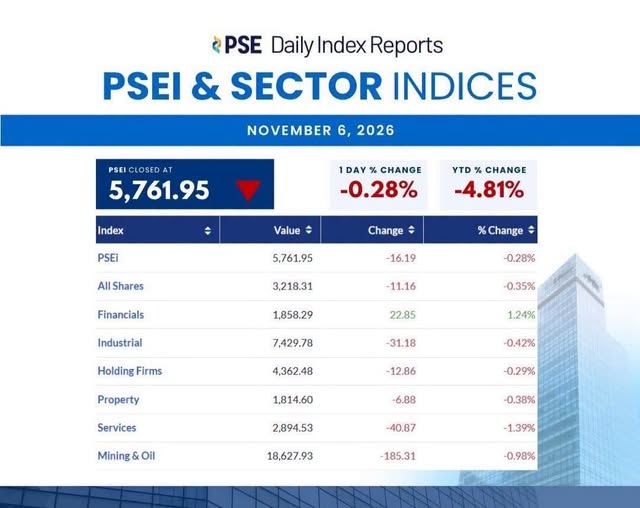
The Philippine Stock Exchange index (PSEi) slipped 0.28 percent to 5,761.95 points, while the broader All Shares index declined 0.35 percent to 3,218.31 points.
Most sectoral indices finished in negative territory, with Services posting the steepest decline at 1.39 percent, followed by Mining and Oil at 0.98 percent.
Industrial shares fell 0.42 percent, Property dropped 0.38 percent, and Holding Firms shed 0.29 percent.
Financials was the only sector to register gains, rising 1.24 percent.
Trading volume reached 815.4 million shares valued at Php 6.36 billion. Declining stocks outnumbered advancing issues, 96 to 69, while 70 remained unchanged.
Regina Capital Development Corporation head of sales Luis Limlingan attributed the market’s weakness to negative developments overseas and cautious investor sentiment.
He said the PSEi followed the decline in global markets, prompting investors to take profits after two consecutive sessions of gains.
“The negative external cues prompted profit-taking across the board as investors opted to lock in gains following two consecutive sessions of advances,” Limlingan said.
He added that investors remained cautious amid persistent macroeconomic uncertainties while waiting for fresh developments that could support a sustained market recovery.
Domestic economic indicators also contributed to market concerns following the release of fresh employment and agricultural production figures from the Philippine Statistics Authority (PSA).
The PSA reported that the country’s unemployment rate increased to 5.4 percent in September, up from 5.3 percent in August.
Meanwhile, crop production declined by 7.8 percent year-on-year to 14.05 million metric tons in the third quarter, compared with 15.25 million metric tons during the same period in 2025.
The weaker economic indicators also weighed on the Philippine peso, which depreciated to Php 63.05 against the US dollar from Thursday’s closing rate of Php 62.97.
The local currency opened at Php 63.02 and traded between Php 62.97 and Php 63.19, with an average exchange rate of Php 63.06.
Foreign exchange trading volume declined to nearly USD 1.2 billion from approximately USD 2 billion in the previous session.
Rizal Commercial Banking Corporation chief economist Michael Ricafort said the peso’s performance was partly influenced by fluctuations in global oil prices, weaker agricultural production, and the latest employment figures.
Ricafort warned that the contraction in agricultural output could weigh on the country’s overall economic performance.
He said the agricultural production report “could lead to slower GDP (gross domestic product) growth.”
The latest market movements reflect continued investor caution over domestic economic conditions and external uncertainties that could affect the Philippines’ growth outlook.