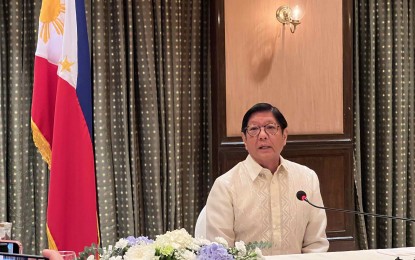
President Ferdinand R. Marcos Jr. wrapped up his five-day state visit to India on Friday, securing USD446 million in direct investment pledges and reaffirming the commitment to enhance cooperation between Manila and New Delhi.
“In terms of actual direct investment, we have already secured USD446 million… that is already what we have decided at the end of this trip,” Marcos stated during a press briefing with the Philippine media delegation before his return to Manila. He expressed optimism for additional commitments, estimating potential investments could reach between USD5.6 billion and USD5.7 billion. “So, malaking bagay talaga (It is really a big deal). India is a very, very strong economy,” he added.
Describing his inaugural visit to India as “a new beginning” for Philippine-India relations, Marcos highlighted the “very encouraging” exchanges he had with Indian leaders and business executives. “The whole range of possibilities has now become clear to us… I am very happy with the results and glad we have opened new lines of communication,” he remarked.
Marcos arrived in New Delhi on August 4, where he met with the Filipino community before engaging in bilateral talks with Prime Minister Narendra Modi and President Droupadi Murmu. During these discussions, both sides witnessed the signing of 13 agreements covering various sectors, including defense, maritime cooperation, agriculture, fintech, and cultural exchange.
In an interview with Indian media, Marcos reaffirmed his administration’s commitment to defending Philippine sovereignty amid ongoing tensions in the Indo-Pacific region. He praised India as a “responsible major power” for adhering to international tribunal rulings on maritime disputes, contrasting this with China’s rejection of the 2016 arbitral award concerning the South China Sea.
The New Delhi leg of the visit concluded with a foreign policy address at the Observer Research Foundation, where Marcos called on democracies to safeguard the global commons and uphold international law.
In Bengaluru, he engaged with Indian and Filipino business leaders from key sectors such as information technology, business process management, fintech, telecommunications, pharmaceuticals, healthcare, manufacturing, and infrastructure. He encouraged Indian firms to “bet on the Philippines” as a strategic investment destination, highlighting the country’s young and skilled workforce and its advantageous location in the Indo-Pacific region.