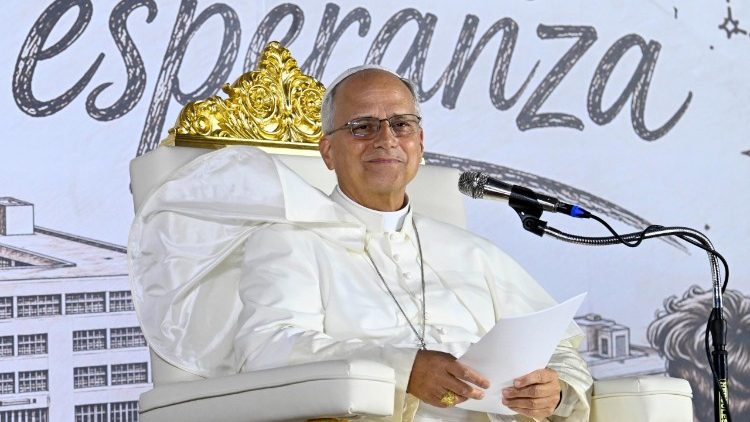

Pope Leo XIV talks to the academe during his visit to the Saint Turibius University in Chiclayo, Peru. (Photo from Vatican News)
Continuing his pastoral tour to Peru, Pope Leo XIV visited the Catholic University of Saint Turibius of Mogrovejo in Chiclayo, where he enjoined educational institutions to foster an encounter between faith and reason and between religion and science through dialogue and inquiry in service of the common good.
The first American pope outlined a broad vision of the role of universities in the modern world, stressing that the quest for truth and knowledge epitomizes service to humanity.
Speaking to students and professors who welcomed him, Leo told the gathering, “invites us to recall the legacy” of St. Turibius of Mogrovejo, whose faith and knowledge “must continue to be the compass that guides research in these classrooms.”
“A university—in particular a Catholic university—is a living community where the search for truth becomes an act of love and service to the great human family,” the 71-year-old pontiff pointed out.
“In a world that is undergoing ‘complex cultural challenges’, he said, “a university is called, above all, to serve Truth—with a capital ‘T’—who Christ, the Saviour of the world,” he cited.
The Holy Father went on to warn against the “temptation” for education simply to become training program for skilled workers, saying indifference to justice for workers and their dignity can lead to oppression and exclusion.
He likewise warned of “the most deadly risk of submission to the technocratic paradigm” to encourage professors and students to exercise critical thinking and to always “see that wisdom that neither machines nor computer programs can possess.”
To accomplish this critical mission, Leo invited his audience to look to the example of St. Turibius who particularly defended the rights and dignity of the indigenous peoples.
“His pastoral work bears witness to how the logic of the incarnation continues to bear fruit in every time and place through the mission of the Church. A university modelled on his example is called to use scientific innovation to bridge social divides and heal society’s wounds,” he cited.
In ending, Leo urged professors and academic leaders “to discover, with wonder and passion, that (their) work is a lofty expression of intellectual charity” and to translate their “scientific expertise . . . into works of social justice, especially for the benefit of the poorest and in the care of creation.”