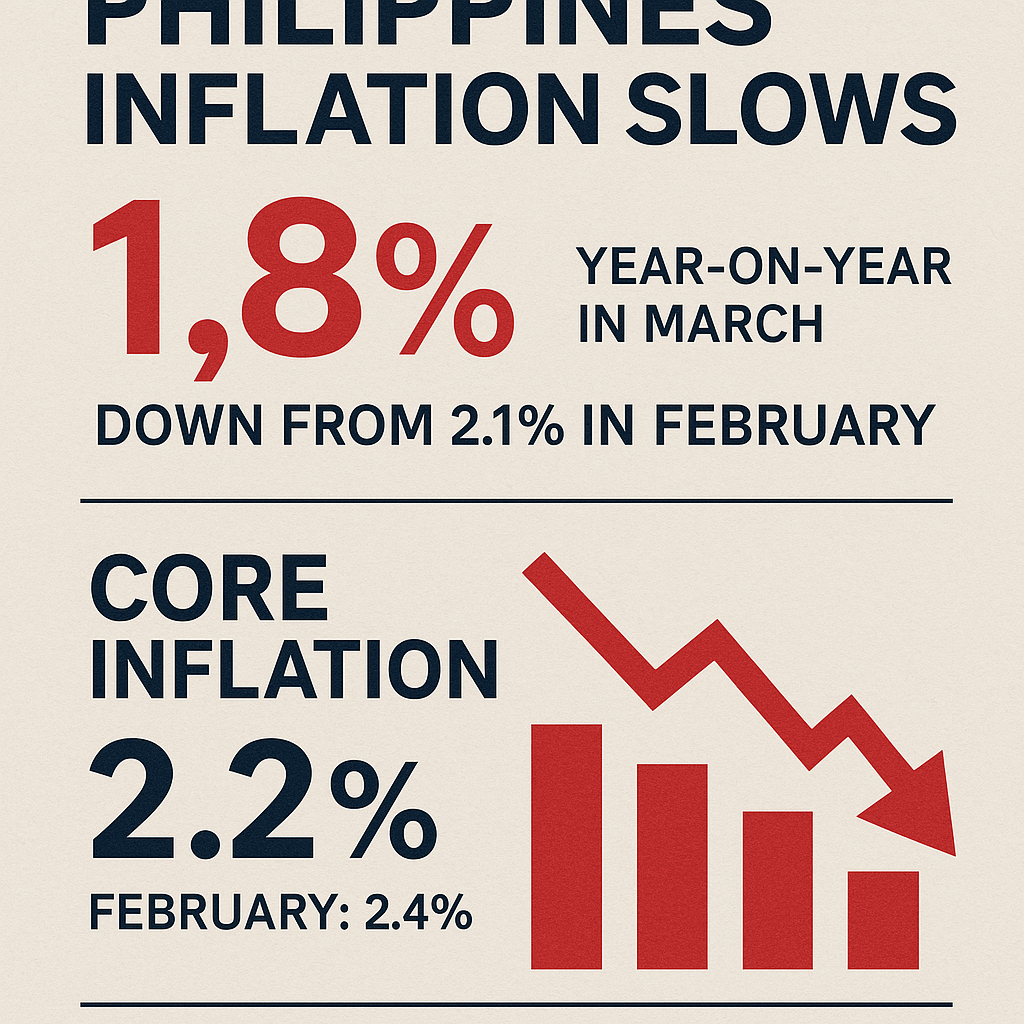

Headline inflation in the Philippines slowed to 1.8% year-on-year in March, down from 2.1% in February, aligning with the lower end of the Bangko Sentral ng Pilipinas’ (BSP) forecast range of 1.7% to 2.5%.
The easing was largely driven by a deceleration in food prices—an important development for Filipino households where food remains a significant portion of daily expenses.
Core inflation, which excludes volatile food and energy items, also moderated to 2.2% from 2.4%, further reinforcing expectations that inflationary pressures remain contained. This development gives the BSP more flexibility in potentially adjusting monetary policy to support domestic demand if needed.
Domestic demand anchors outlook
The Philippines now faces growing external headwinds after the U.S. government announced a broad set of tariffs on Asian economies. While the Philippines was not directly named among the affected countries, the regional fallout from President Donald Trump’s new tariffs could still have indirect effects.
Countries like China, Vietnam, Thailand, and South Korea—all key trading partners in the region—are among those facing levies ranging from 24% to 54%, effective April 9.
These trade disruptions have already sent shockwaves through regional stock markets, with Japan’s Nikkei225 falling 3.5%, Hong Kong’s Hang Seng down 1.7%, and Australia’s S&P/ASX200 losing 1.2%. While Philippine markets have been more resilient so far, continued global uncertainty could still weigh on investor sentiment and trade flows.
Opportunities for policy response
With inflation under control and the peso benefiting from a relatively weaker U.S. dollar—which has already dropped 5% this year—the BSP may have more room to cut interest rates if domestic growth shows signs of slowing.
This is particularly relevant for the Philippines, where the economy is largely driven by local consumption rather than exports.
Unlike export-heavy economies such as Taiwan and Singapore, the Philippines may be better positioned to weather the current trade storm by stimulating local demand. A potential rate cut could help keep business and consumer confidence steady amid global uncertainties.
Recession weighs on outlook
However, risks remain. President Trump’s unpredictable foreign policy and aggressive tariff moves have created a cloud of uncertainty over global trade, particularly in Asia.
While Philippine exports are not the most vulnerable, the knock-on effects of reduced demand and weaker regional trade could still affect the country’s manufacturing sector and broader economic activity.
Philippine businesses, already cautious due to global headwinds, may delay investments if global sentiment continues to deteriorate. Meanwhile, households could become more conservative in spending, especially if job markets and remittances come under pressure.
Still, with inflation contained and monetary space available, the Philippines remains in a relatively strong position to act swiftly and shield its economy from prolonged global turbulence.