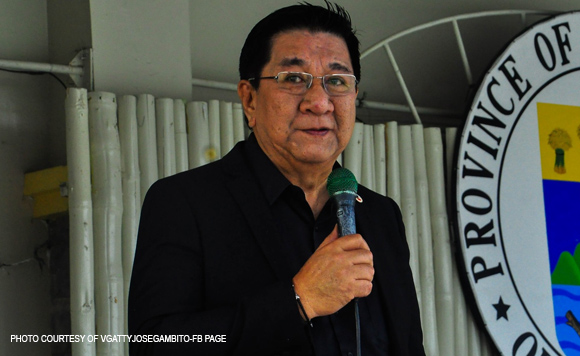

Nueva Vizcaya governor ‘Jing’ Gambito. (Photo from Politiko North Luzon)
BAYOMBONG, Nueva Vizcaya — Following the series of tremors that has rocked the country in recent days, the provincial government of Nueva Vizcaya and the Philippine Institute of Volcanology and Seismology (PHIVOLCS) have joined forces to strengthen disaster preparedness and earthquake monitoring with plans to install a Strong Motion Station (SMS) at the provincial capitol in Bayombong town.
The initiative comes amid the recent earthquakes and aftershocks in several parts of the country, particularly in Davao Oriental and Cebu, which now highlights the necessity to upgrade seismic monitoring and responsive infrastructure planning across the archipelago.
Unlike traditional seismographs that detect minor seismic activity, an SMS is specifically designed to record intense ground shaking during earthquakes. It is equipped with accelerographs that measure ground motion in three directions, providing critical data for seismic hazard assessment, earthquake research and the engineering of earthquake-resilient structures.
Nueva Vizcaya governor Jose ‘Jing’ Gambito disclosed that they have already requested the installation of the SMS near the Provincial Disaster Risk Reduction and Management Office (PDRRMO) in Bayombong to support proactive and science-based disaster risk reduction.
“We are investing in stronger earthquake monitoring as part of our preparedness efforts. This station will give us real-time data to protect our communities and guide safer infrastructure across Nueva Vizcaya,” Gambito announced.
For his part, PDRRM officer Robert Corpuz stated that the SMS will occupy a 15-square-meter area within the PDRRM compound near the municipal hall and will have a 100-kilometer detection radius. It is also solar-powered, ensuring continued operation during power outages caused by seismic events.
“The (monitoring) station will gather crucial data to support early warning systems and post-event analysis. It will also aid in identifying local soil types and site-specific ground responses, information that the Provincial Engineering Office can use to improve building designs and ensure structural safety,” Corpuz cited.
This will be the second SMS in the province, following the installation of the first unit in Aritao town northwest of the provincial capitol.