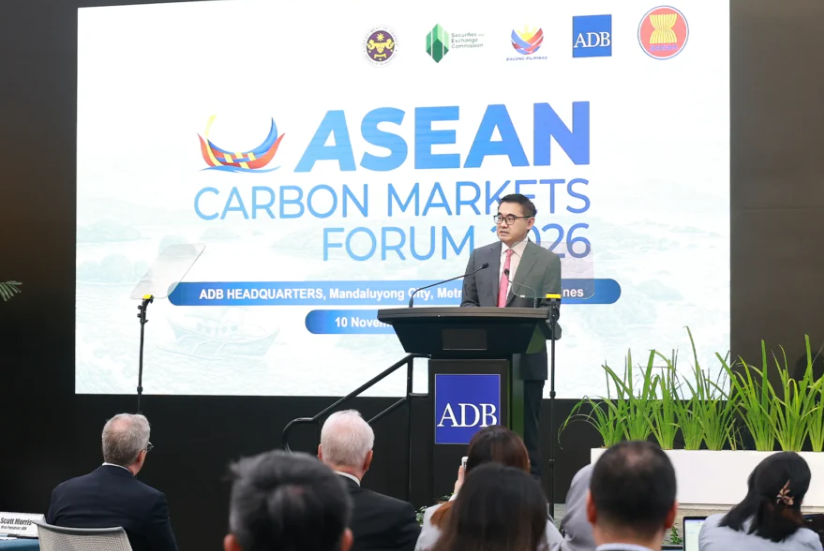

The Department of Finance (DOF) is spearheading regional efforts to develop and harmonize carbon markets across Southeast Asia to attract private investments, accelerate climate action and support ASEAN’s transition toward a low-carbon and climate-resilient economy.
Finance Secretary Frederick Go said carbon markets could play a significant role in mobilizing private capital for projects aimed at reducing greenhouse gas emissions, expanding renewable energy and supporting nature-based environmental solutions.
“Carbon markets are a vital instrument for ASEAN prosperity. By creating a market for trading carbon credits, we can attract investments for climate action. They unlock private capital to reduce emissions. They also channel investments into renewable energy and nature-based solutions,” Go said.
Carbon markets allow companies that generate greenhouse gas emissions to purchase carbon credits from projects that reduce or remove emissions. The system creates financial incentives for businesses and investors to support cleaner technologies and environmental protection initiatives.
Under the Philippines’ ASEAN 2026 Chairship, the DOF Climate Finance Policy Group co-hosted the ASEAN Carbon Markets Development and Harmonization Forum 2026 with the Securities and Exchange Commission (SEC), in partnership with the Asian Development Bank (ADB).
The forum, held under the ASEAN Climate Finance Policy Platform, brought together member states to discuss policies governing carbon markets, cross-border carbon credit trading and the alignment of national carbon registries and monitoring systems.
The initiative forms part of the Philippines’ Priority Economic Deliverable on “Sustainable and Resilient ASEAN Capital Markets,” which is aligned with the ASEAN Capital Markets Forum Action Plan 2026–2030.
During the discussions, the Philippines explored the possibility of conducting an ADB-supported ASEAN Carbon Market Implementation and Interoperability Study.
The proposed study aims to help ASEAN member states develop their respective carbon markets, improve compatibility among national systems and mobilize additional private financing for climate-related projects.
Go said the initiative complements the Philippines’ Sustainable Finance Framework, Philippine Climate Finance Strategy and updated Nationally Determined Contributions, which outline the country’s commitments to addressing climate change.
The DOF also cited Executive Order No. 127, series of 2026, which established the Philippine Carbon Market Policy Framework.
According to the department, the framework positions the Philippines to participate more actively in regional and international carbon markets while opening opportunities for investments in environmentally sustainable projects.
ADB Vice President for East, Southeast Asia and the Pacific Scott Morris emphasized the importance of establishing credible regulations, viable investment opportunities and compatible carbon trading systems across the region.
“The opportunity for ASEAN is significant. Countries that put credible rules, investable projects, and interoperable markets in place now would be best positioned to attract carbon finance in the years ahead,” Morris said.
He added that the ADB would continue supporting ASEAN member states in developing carbon markets that could expand access to climate financing.
The regional initiative is expected to strengthen cooperation among ASEAN economies as they seek to balance economic development with emissions reduction, environmental sustainability and resilience against climate-related risks.