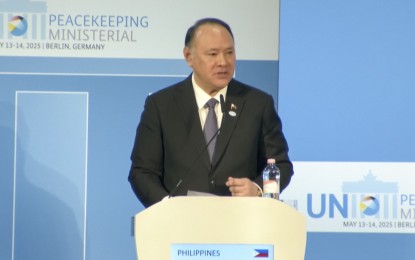
The Indian-made BrahMos cruise missile system, three batteries of which were acquired by the Philippines in 2022, plays a crucial role in the country’s deterrent capabilities, according to Department of National Defense (DND) Secretary Gilberto Teodoro Jr.
“The experience has been very, very enlightening for us. It is an important part of our deterrent package, and we will continue to advance discussions on how we can envelop the partnership on a sustainable basis,” Teodoro stated in response to inquiries from Indian media regarding the BrahMos missile’s service in the Philippines and potential plans for additional acquisitions.
Teodoro is part of President Ferdinand R. Marcos Jr.’s delegation during his state visit to India from August 4 to 8. Earlier, Marcos indicated that the Philippines is in the process of acquiring more BrahMos cruise missile systems as part of the ongoing Armed Forces of the Philippines (AFP) modernization program.
In January 2022, then-defense chief Delfin Lorenzana and BrahMos Aerospace director general Atul Dinkar Rane signed a contract for three BrahMos cruise missile system batteries, valued at PHP18.9 billion, in a virtual ceremony. A battery typically consists of three to six launchers, along with monitoring and tracking components and logistics support vehicles. The first BrahMos battery was delivered in April of the previous year.
However, the DND and the AFP have yet to provide updates regarding the status of the BrahMos acquisition project.
The BrahMos cruise missile can be launched from various platforms, including ships, aircraft, submarines, or land. It boasts a top speed of approximately Mach 2.8 (about 3,400 km per hour) and is capable of carrying warheads weighing between 200 kg and 300 kg. This weapon platform is expected to address the military’s weaknesses and vulnerabilities in sea control, anti-access/area-denial (A2/AD), and coastal and island defense operations.
In addition to military cooperation, Teodoro emphasized the importance of leveraging commonalities and kinship between the Philippines and India for mutual resilience and growth amid complex regional challenges. “It is only natural to throw back to our civilizational ties and our people-to-people exchanges, and to rekindle these into mutual resilience, growth, and helping each other grow,” he remarked regarding the establishment of the Philippines–India Strategic Partnership, launched by Marcos and Indian Prime Minister Narendra Modi.
Teodoro noted that there are many lessons to be learned from India and vice versa, and it is essential to leverage these similarities and kinships for the benefit of future generations.
He also highlighted that India is among the countries that have acknowledged the 2016 Arbitral Award on the South China Sea. Furthermore, he shared that the Philippine and Indian Navies recently conducted their inaugural bilateral maritime cooperative activity (MCA). “The first MCA was just concluded in international waters and, of course, territorial waters of the Philippines,” he stated.
Teodoro added that it is fitting for the two navies to conduct their first MCA as both nations celebrate the 75th anniversary of their diplomatic relations. “It is fitting that both our navies commemorate this, too, with the first visible mutual or joint activity that we conduct,” he concluded.