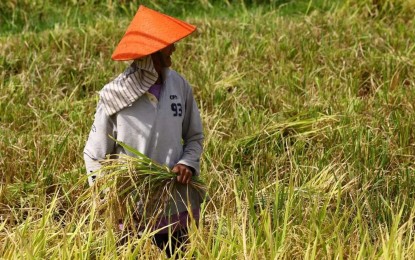
The Marcos administration’s intensified agricultural support and increased areas harvested for palay (unhusked rice) have contributed to the Philippines achieving a historic high in palay production for the first half of the year, according to the Department of Agriculture (DA).
Based on the latest data from the Philippine Statistics Authority (PSA), the country produced over 9.077 million metric tons (MT) of palay from January to June 2025, surpassing the previous all-time high of 9.026 MT for the same period in 2024 and last year’s production of 8.53 million MT.
Agriculture spokesperson Assistant Secretary Arnel de Mesa attributed this success to the government’s interventions aimed at achieving food security and affordability, in line with President Ferdinand R. Marcos Jr.’s directives. “Almost 600,000 metric tons ang itinaas. Malaki iyon (the increase. It’s significant), historic high. Kasi ang (Because the) highest was recorded in 2024,” he stated in an interview on Wednesday.
De Mesa highlighted that the support provided, including mechanization and irrigation, is now yielding positive results. “Our support, including mechanization and irrigation, is now bearing fruits. And actually, we have distributed many good quality seeds,” he added.
In terms of mechanization, 37,085 farm machines have been distributed to 7,338 farmer groups, while 12,445 units of farm machinery and equipment were provided to 6,869 farmer cooperatives and associations, according to data from the State of the Nation Address (SONA) by the Presidential Communications Office.
For the rice processing system, 101 out of the targeted 151 rice processing facilities (RPS) are already established and operational as of May. Additionally, a total of 88,646 hectares have been irrigated under the Marcos administration’s irrigation expansion, benefiting 1.27 million farmers nationwide.
Around PHP 23 billion worth of fertilizer aid has also been granted to 5.66 million farmers, further boosting local production, as noted by De Mesa.
The all-time high yield was also attributed to an increase in harvested areas and favorable weather conditions. The PSA data indicated that palay harvested areas rose to more than 2.12 million hectares, compared to 2.065 million hectares for the same period in 2024.
“Iyong tumataas siya ng gano’n, mas malaking bagay iyan. At ma-dispel na rin iyong sinasabi nila na iyong mga farmers hindi na nagtatanim. When in fact, lumalaki ‘yung harvested area,” de Mesa remarked. (If it’s increasing at that level, that’s even a bigger thing. So the claims that farmers are no longer planting may be dispelled. When in fact, the harvested area is growing.)
He noted that farmers may have been “encouraged” by last year’s higher earnings despite increased production costs, as the average farmgate price of palay rose to PHP 23.48 in 2025, up from PHP 19.88 in 2024. This increase in farmgate prices resulted in a higher gross return of PHP 95,906 per hectare and a net return of PHP 36,211 per hectare, compared to PHP 82,914 and PHP 26,423, respectively, in 2024, based on recent PSA data.
This translates to a higher net profit-cost ratio of PHP 0.61 for every kg of palay sold, compared to PHP 0.47 in 2024. With the output for the first half of 2025, De Mesa expressed optimism that the Philippines may achieve its record-high target of 20.46 million MT in annual palay production.The Marcos administration’s intensified agricultural support and increased areas harvested for palay (unhusked rice) have contributed to the Philippines achieving a historic high in palay production for the first half of the year, according to the Department of Agriculture (DA).
Based on the latest data from the Philippine Statistics Authority (PSA), the country produced over 9.077 million metric tons (MT) of palay from January to June 2025, surpassing the previous all-time high of 9.026 MT for the same period in 2024 and last year’s production of 8.53 million MT.
Agriculture spokesperson Assistant Secretary Arnel de Mesa attributed this success to the government’s interventions aimed at achieving food security and affordability, in line with President Ferdinand R. Marcos Jr.’s directives. “Almost 600,000 metric tons ang itinaas. Malaki iyon (the increase. It’s significant), historic high. Kasi ang (Because the) highest was recorded in 2024,” he stated in an interview on Wednesday.
De Mesa highlighted that the support provided, including mechanization and irrigation, is now yielding positive results. “Our support, including mechanization and irrigation, is now bearing fruits. And actually, we have distributed many good quality seeds,” he added.
In terms of mechanization, 37,085 farm machines have been distributed to 7,338 farmer groups, while 12,445 units of farm machinery and equipment were provided to 6,869 farmer cooperatives and associations, according to data from the State of the Nation Address (SONA) by the Presidential Communications Office.
For the rice processing system, 101 out of the targeted 151 rice processing facilities (RPS) are already established and operational as of May. Additionally, a total of 88,646 hectares have been irrigated under the Marcos administration’s irrigation expansion, benefiting 1.27 million farmers nationwide.
Around PHP 23 billion worth of fertilizer aid has also been granted to 5.66 million farmers, further boosting local production, as noted by De Mesa.
The all-time high yield was also attributed to an increase in harvested areas and favorable weather conditions. The PSA data indicated that palay harvested areas rose to more than 2.12 million hectares, compared to 2.065 million hectares for the same period in 2024.
“Iyong tumataas siya ng gano’n, mas malaking bagay iyan. At ma-dispel na rin iyong sinasabi nila na iyong mga farmers hindi na nagtatanim. When in fact, lumalaki ‘yung harvested area,” de Mesa remarked. (If it’s increasing at that level, that’s even a bigger thing. So the claims that farmers are no longer planting may be dispelled. When in fact, the harvested area is growing.)
He noted that farmers may have been “encouraged” by last year’s higher earnings despite increased production costs, as the average farmgate price of palay rose to PHP 23.48 in 2025, up from PHP 19.88 in 2024. This increase in farmgate prices resulted in a higher gross return of PHP 95,906 per hectare and a net return of PHP 36,211 per hectare, compared to PHP 82,914 and PHP 26,423, respectively, in 2024, based on recent PSA data.
This translates to a higher net profit-cost ratio of PHP 0.61 for every kg of palay sold, compared to PHP 0.47 in 2024. With the output for the first half of 2025, De Mesa expressed optimism that the Philippines may achieve its record-high target of 20.46 million MT in annual palay production.