
(Photo courtesy of Philippine Embassy in Korea)
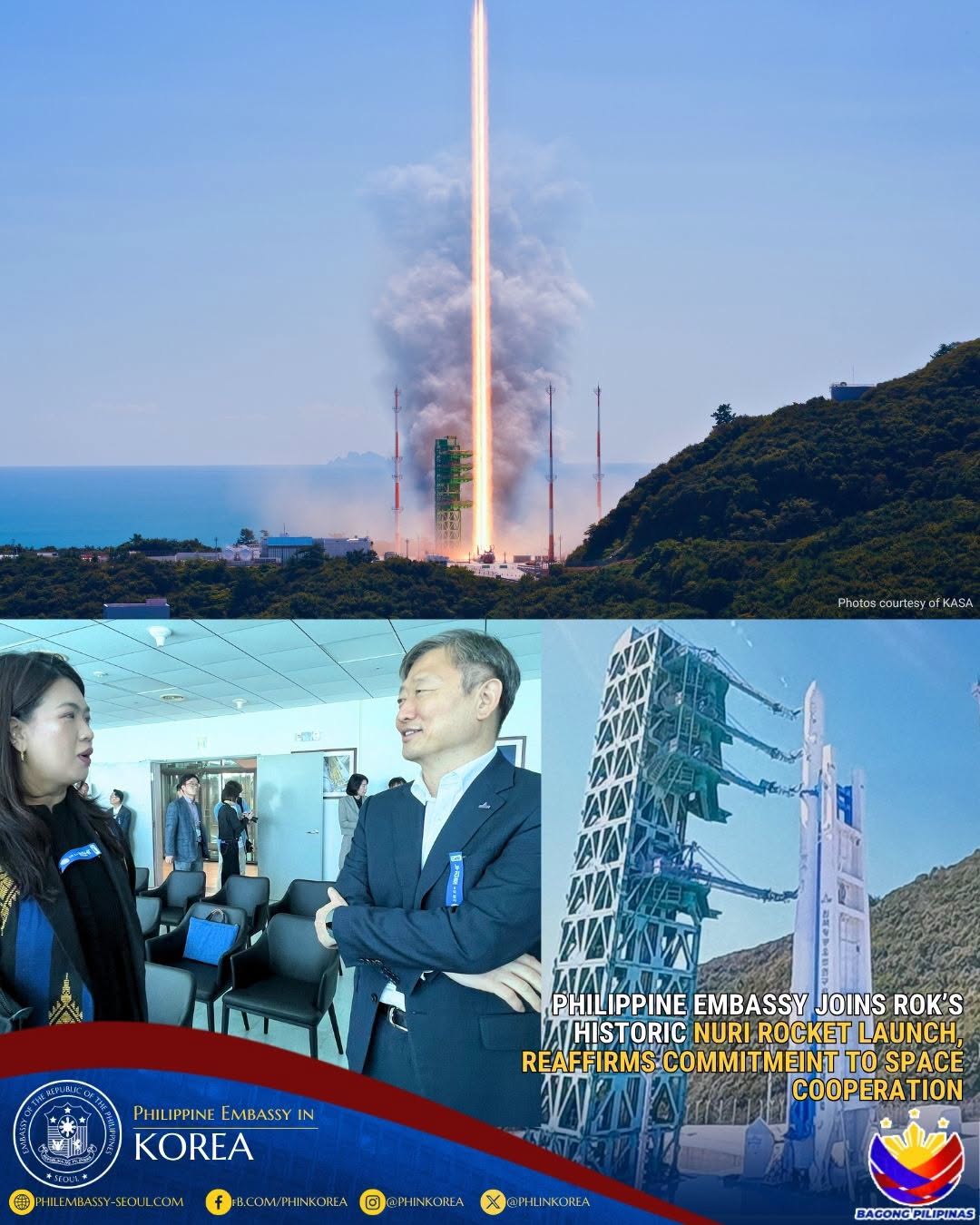
GOHEUNG, SOUTH KOREA — The Philippine Embassy in Seoul witnessed the successful fifth launch of South Korea’s domestically developed Nuri rocket at the Naro Space Center in Goheung on October 7, 2026, reaffirming the two countries’ commitment to advancing space cooperation.
The launch successfully deployed five New-space Earth Observation Satellite Constellation for National Safety (NEONSAT) microsatellites, marking South Korea’s first domestically launched microsatellite constellation.
Designed to support national security, Earth observation, and disaster response, the satellites established ground communications and transmitted their first images within 24 hours of deployment.
Second Secretary and Consul Reisha Olavario and Economic Attaché Charmie Fugaban represented Philippine Ambassador Bernadette Therese Fernandez during the launch, following an invitation from the Korea AeroSpace Administration (KASA).
KASA officials welcomed the Embassy’s participation and recognized its continued engagement in South Korea’s space activities since 2021.
Officials from the Korea Aerospace Research Institute (KARI) also expressed support for expanding cooperation with the Philippines in space research and technology development.
The event highlighted ongoing collaboration between the Philippine Space Agency (PhilSA) and South Korean space company Perigee Aerospace, particularly in developing Filipino expertise in rocket technology.
Ten Filipino engineers are currently undergoing advanced training in South Korea ahead of the Philippines’ planned liquid-fueled sounding rocket launch in Cagayan in 2027.
The initiative aims to strengthen the country’s domestic space capabilities, promote technology transfer, and expand scientific and industrial partnerships.
The Philippine Embassy congratulated South Korea on the successful launch and reiterated its commitment to strengthening bilateral cooperation in satellite applications, space research, technology development, and technical training.
Both countries are also exploring opportunities to use space technology to improve disaster preparedness, environmental monitoring, maritime safety, and national development.