
(Photo courtesy of CCC)
The Philippines has reaffirmed its commitment to reducing greenhouse gas emissions while calling for greater international support to address the worsening impacts of climate change ahead of the 31st United Nations Climate Change Conference (COP31).
Despite accounting for only a small share of global emissions, the country remains highly vulnerable to extreme weather events and other climate-related disasters, prompting the government to strengthen its climate commitments and advocate for climate justice.
The Philippines submitted its updated Nationally Determined Contribution (NDC) to the United Nations Framework Convention on Climate Change (UNFCCC) ahead of COP31, scheduled for November 9 to 20 in Antalya, Türkiye.
The NDC outlines the country’s climate action commitments under the Paris Agreement, which requires participating nations to submit updated plans every five years.
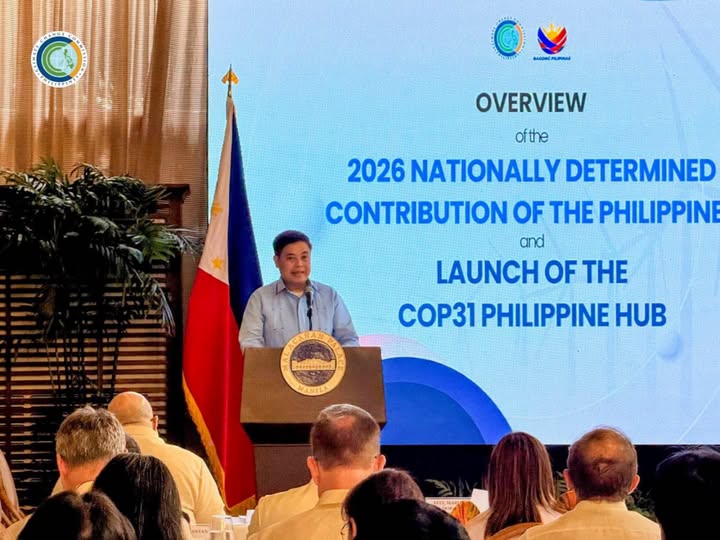
During a presentation at Malacañang on Tuesday, the Climate Change Commission (CCC) unveiled the country’s 2026 NDC, which maintains a 75-percent net greenhouse gas emissions reduction and avoidance target for 2025 to 2035, measured against projected cumulative emissions under a business-as-usual scenario.
Of the total target, 7 percent will be achieved through domestic resources and government initiatives, while the remaining 68 percent depends on international financing, technology transfer and other forms of assistance.
The updated commitment covers major sectors, including energy, transportation, industrial processes, agriculture, waste management, forestry and other land uses.
Compared with the country’s 2021 NDC, which also targeted a 75-percent reduction and avoidance of emissions, the latest plan increases the unconditional component from 2.71 percent to 7 percent, reducing the portion dependent on international support from 72.29 percent to 68 percent.
PH seeks climate justice, international financing
CCC Executive Director Robert Borje emphasized that the Philippines’ climate commitments reflect the principle of climate justice, particularly for developing countries that contribute relatively little to global emissions but face severe consequences from climate change.
“It really is a question of climate justice and equity… What the NDC does is it provides a strong signal to the international community that we are committed to lowering our greenhouse gas emissions, but also there is an actual plan and areas in which our partners can invest in the Philippines,” Borje said.
He stressed that the updated NDC goes beyond setting emission reduction targets by establishing a framework for implementing climate policies and attracting investments.
“For the Philippines, the NDC is not simply a statement of ambition. It is a framework for action,” he added.
According to the CCC, the 2026 NDC incorporates updated scientific findings, more recent climate data and 211 policies and measures designed to strengthen mitigation and adaptation efforts.
The plan also seeks to mobilize international financing, technological assistance and capacity-building support to help the country meet its climate commitments.
The commission said the updated NDC was developed through 253 stakeholder engagements, including technical meetings, workshops and consultations involving government agencies, development partners, civil society organizations, private companies and academic institutions.
Climate resilience, inclusive development prioritized
Beyond reducing emissions, the updated climate action plan emphasizes strengthening disaster resilience, protecting vulnerable communities and ensuring that the transition toward a low-carbon economy benefits all sectors of society.
Among its priorities is integrating climate adaptation measures into infrastructure development, ecosystem protection and public health programs in line with the country’s National Adaptation Plan.
The NDC also promotes gender equality, disability inclusion and greater participation of Indigenous Peoples, senior citizens and other vulnerable groups in climate-related programs.
It calls for a just transition that protects workers and communities as industries shift toward cleaner and more sustainable technologies.
Local government units are also expected to play a central role in implementing climate policies, while young Filipinos will be encouraged to participate through employment opportunities, skills development and leadership programs.
Other priorities include expanding nature-based solutions, promoting circular economy practices and aligning climate initiatives with the United Nations Sustainable Development Goals.
Stronger coordination needed
The CCC emphasized that achieving the country’s climate targets will require sustained coordination among government agencies, local authorities, businesses and international development partners.
It also underscored the importance of securing adequate investments, strengthening institutional capabilities and establishing monitoring systems to measure emissions reductions and improvements in climate resilience.
The commission said the updated NDC would serve as a guide for implementing climate programs and identifying areas where international partners could provide financial and technical assistance.
As the Philippines prepares for COP31, the government is expected to highlight the need for equitable climate financing and stronger international cooperation to help vulnerable developing nations meet their climate commitments while protecting communities from increasingly severe climate-related disasters.