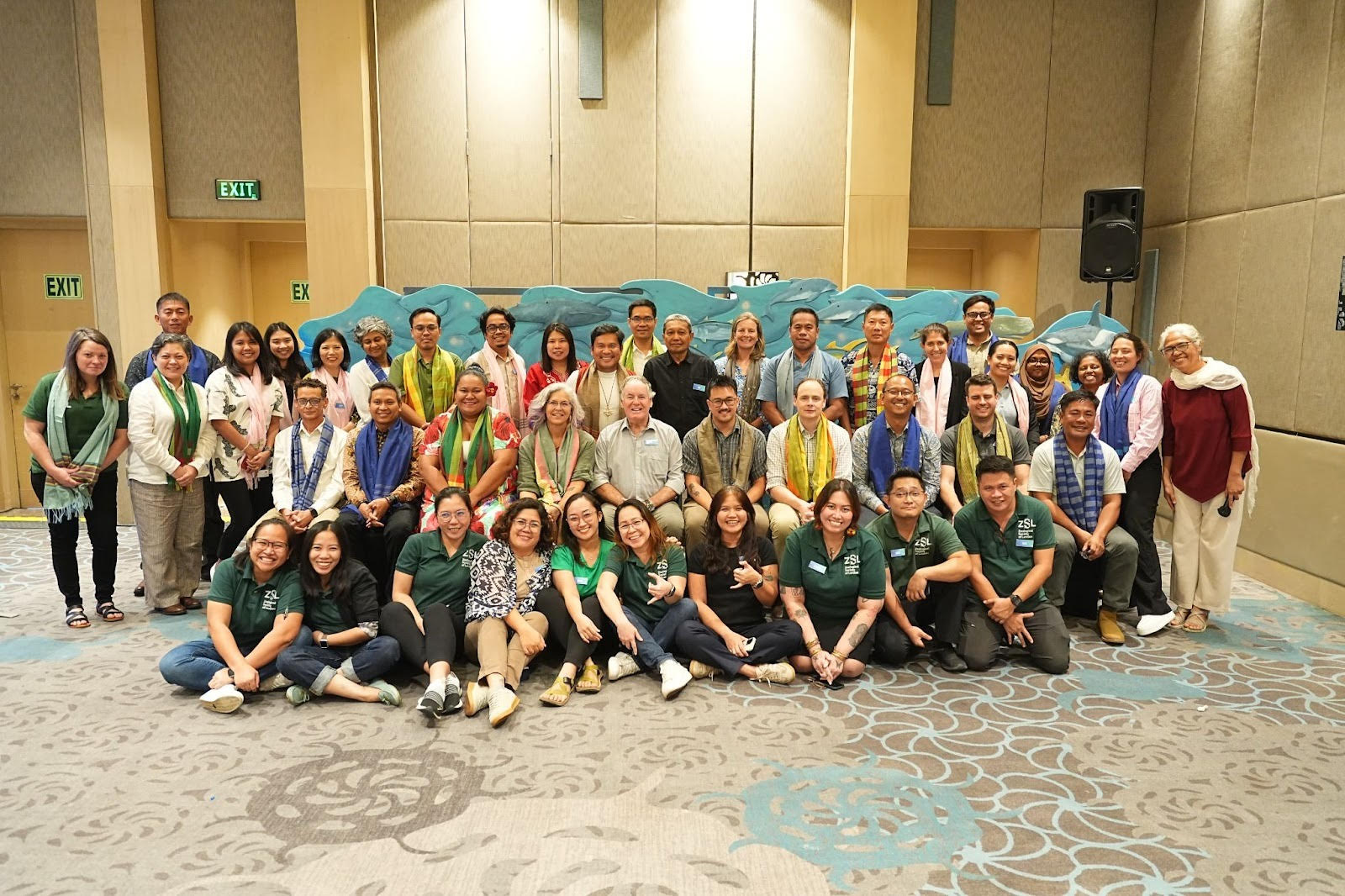

Representatives from the Philippines, Indonesia, Thailand, Malaysia, Maldives, Vietnam, and the Solomon Islands — from government, academe, and NGOs — gathered in Iloilo City for the Asia Regional Large-Scale MPA Workshop, organized by ZSL Philippines with the Blue Nature Alliance and Big Ocean, to share insights and advance science-based, community-driven marine conservation.
Iloilo City, Philippines — With the global race to protect 30 percent of the world’s oceans by 2030 gaining urgency, the Philippines has positioned itself at the center of Asia’s marine conservation push by hosting the Asia Regional Large-Scale Marine Protected Area Workshop in Iloilo City.
Convened by Zoological Society of London – Philippines in partnership with the Blue Nature Alliance, the gathering brought together regional leaders from government, academe, and civil society to explore how science-based and community-driven approaches can unlock large-scale ocean protection across Asia.
Representatives from the Philippines, Indonesia, Thailand, Malaysia, Maldives, Vietnam, and the Solomon Islands convened for the two-day workshop to exchange lessons and confront shared challenges, from policy gaps and governance hurdles to climate change impacts, illegal fishing, and the complexities of protecting marine ecosystems that cross national boundaries.
The event was co-hosted by Big Ocean, a peer-learning network created by and for managers of large-scale marine areas, with technical and financial support from the Alliance, which aims to help conserve 18 million square kilometers of ocean worldwide.
Asia’s role in ocean stewardship was a recurring theme throughout the discussions. With the world’s highest nearshore marine biodiversity, the region has long been a leader in coastal protection, but participants emphasized that meeting the 30×30 target will require expanding conservation efforts beyond the traditional 12-nautical-mile boundary.
Alliance Executive Director Laure Katz underscored the need to strengthen links between science, policy, and communities, while laying the groundwork for an Asia Regional LSMPA Community of Practice and a shared roadmap for protecting oceans at scale.
The workshop also highlighted how regional collaboration can accelerate progress. By pooling expertise and aligning priorities across sectors and countries, participants agreed that Asia can move faster toward durable, inclusive marine protection.
Katz noted that the Blue Nature Alliance is already working with more than 130 partners globally to advance conservation across five percent of the world’s ocean, a contribution she described as critical to achieving the broader 30×30 ambition.
Participants identified the most pressing threats facing Asia’s marine ecosystems as pollution and climate change, illegal, unreported, and unregulated fishing, sea-level rise, and widespread habitat destruction. In response, they called for closer alignment between marine conservation and food security goals, the development of long-term and equitable financing mechanisms backed by governments, greater policy harmonization to ease implementation, and stronger public participation to build lasting support for protection efforts.
These recommendations, participants said, reflect Asia’s capacity to innovate and lead in building a resilient foundation for ocean conservation.
Big Ocean Director Naiʻa Lewis described the moment as a turning point, saying Asia has the potential to usher in a second wave of large-scale marine protection, one that proves fisheries management, food security, and conservation can move forward together rather than in conflict.
The Philippines’ own ambitions were showcased through discussions on the proposed Philippine Rise Ocean Conservation Area. Led by ZSL in partnership with the Department of Agriculture–Bureau of Fisheries and Aquatic Resources, Fisheries Management Area 1, and the Alliance, the initiative would cover roughly 150,000 square kilometers, or about 7.5 percent of Philippine waters.
If realized, it would become the largest single marine protected area in Asia, designed to safeguard biodiversity while supporting long-term food security.
ZSL Philippines Country Director Edwina Garchitorena acknowledged that the shift toward large-scale protection represents a major change in how marine conservation has traditionally been approached. She said challenges remain, from ensuring community understanding to aligning governance structures, but emphasized that the potential impact makes the effort worthwhile and necessary.
Katz added that the momentum for comprehensive protection, spanning both nearshore and offshore waters, is already building across Asia, with governments in the Philippines and Indonesia taking bold steps to translate commitments into concrete action.
As the workshop concluded, participants agreed that large-scale marine protection is no longer an abstract ideal but an increasingly achievable goal when anchored in science, inclusive policy, and community participation. Organizers described the Iloilo gathering as the start of a longer journey, one aimed at inspiring decisive action that benefits both people and nature.
ZSL, together with the Alliance, Big Ocean, and regional partners, plans to continue strengthening large-scale marine governance and mobilizing collective action to help Asia deliver on the global 30×30 ocean protection promise.