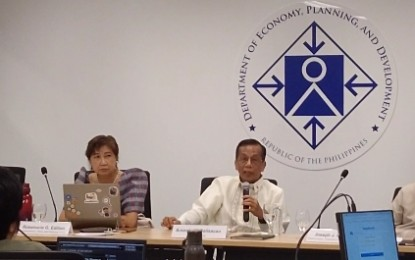

Department of Economy, Planning, and Development Undersecretary Rosemarie Edillon (left) and Secretary Arsenio Balisacan during the agency’s year-end briefing in Mandaluyong City on Monday (Dec. 1, 2025). Balisacan said a 5-percent full year growth is still respectable for the Philippine economy this year, even if this is below the full year target of between 5.5 percent to 6.5 percent target, adding this growth level remains robust compared to other countries in the region. (PNA photo by Joann Villanueva)
The government’s chief economic planner says a five-percent expansion for the Philippine economy in 2025 remains a solid performance compared to regional peers, even as the country confronts challenges that were largely beyond its control.
Arsenio Balisacan, Secretary of the Department of Economy, Planning, and Development (DEPDev), noted that growth averaged five percent as of the third quarter, with quarterly figures clocking in at 5.4 percent, 5.5 percent, and a slower four percent. To hit the government’s full-year target of 5.5 to 6.5 percent, the final quarter would need to deliver a steep seven-percent climb — a difficult but not impossible feat, he said.
Balisacan admitted the recent natural disasters and ongoing investigations into questionable flood-control projects have posed headwinds, slightly dampening momentum. But he stressed that the country’s economic fundamentals remain “sound and resilient,” underscoring the need to protect progress already gained.
He said inflation continues to ease as rice and basic goods stabilize, the labor market stays strong, banks remain healthy, the peso maintains broad stability against the US dollar, and the fiscal deficit has narrowed to around five percent of GDP.
“Only by keeping our growth momentum through steady and sound economic policies — and a steadfast commitment to uplift the lives of ordinary Filipinos — can we earn and maintain our people’s trust in government,” he said.
Moving forward, the administration will prioritize social protection programs to help communities recover from recent calamities — a move Balisacan said will not only restore livelihoods but also stimulate overall growth. He added that the Development Budget Coordination Committee (DBCC) will meet on December 9 to reassess the latest developments and their implications on next year’s targets.
“What we want to ensure is that projects crucial to economic activity and social protection — especially those supporting disaster recovery — move quickly,” he said.
Balisacan emphasized that strong macroeconomic pillars and ongoing structural reforms are helping lay the foundation for a more competitive, investment-ready economy. Sustaining this trajectory, he said, requires credible institutions, transparent governance, and policies that build public trust.
“Trust is not just an outcome of development; it is a precondition for it,” he added.