
(Courtesy of ANSA)
ROME – The names of the “papabili,” or likely papal candidates, have been circulating in the media for some time amid Pope Francis’s last illness and amid a geography of the conclave of cardinal electors that he radically changed during his 12-year pontificate, opening it up to newer and faster-growing zones of Catholic worship.
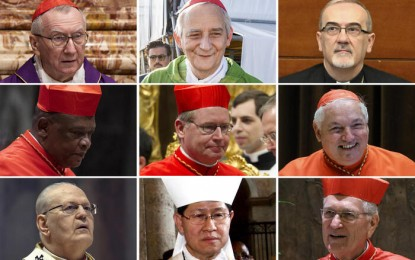
The top papabili at the moment reportedly include Vatican Secretary of State Pietro Parolin, Archbishop of Bologna and Italian bishops conference (CEI) president Matteo Zuppi (also Ukraine envoy), the Patriarch of Jerusalem Pierbattista Pizzaballa, Hungarian Peter Erdo, France’s Jean-Marc Aveline, Dutchman Willem J. Eijk, Filipino Luis Tagle to represent the rising Asian Church, the Congolese Fridolin Ambongo Besungu to embody the booming African reality, and Brazilian Leonardo Ulrich Steiner, Archbishop of Manaus, for the equally increasing Latin American zone of interest, which boasted its first pontiff in the Argentine Francis.
Some 135 cardinals will take part in the conclave, of whom 108 were named by Francis, 22 by his German predecessor Benedict XVI, and five by the previous Polish pope John Paul II.
One of those named by Francis was one of his fiercest critics, Germany’s Gerhard Ludwig Mueller.
Other opponents of Francis’s more liberal attitudes include several African bishops where even talking about homosexuality is taboo, and a swathe of conservative American cardinals.
The college of cardinals under Francis became ever less Eurocentric, ever less Italian and Western led, showing a more generous gaze on the peripheral realities of the Church, the “frontier churches” across the globe.
Some 59 cardinals will come from Europe (19 from Italy), 37 from the Americas (16 from North America, four from Central America, 17 from South America), 20 cardinals from Asia, 16 from Africa, and three from Oceania.
The issues facing the vote in the conclave, Church watchers say, are representative of a Church less entrenched in the defense of old privileges and vested interests, more open to healing the wounds of humanity in all corners of the globe, to the defense of Creation, to poverty and inequality in all their dimensions, to the peripheries, as Francis defined them, “both physical and existential.”
A huge question mark, not only in relation to the armed conflicts that are bloodying the planet today, with the “third world war fought piecemeal” also coined by Pope Francis, is the relationship with politics, in a world that from this point of view is experiencing a phase of rapid change and evolution. The youngest member of the conclave will be the Ukrainian Mykola Byčok, who turned 45 on Feb. 13.
The oldest is the Spaniard Carlos Osoro Sierra, who turns 80 on May 16 and may thus be disqualified from voting if the rites drag on, followed by only a month by the Guinean Robert Sarah. (ANSA)