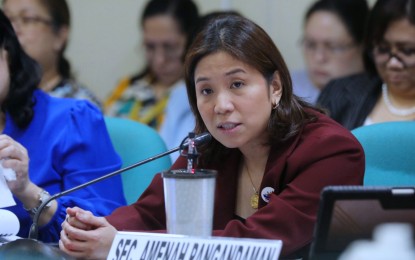
Budget Secretary Amenah Pangandaman on Monday warned contractors and suppliers that long-standing fraudulent practices in government bidding would no longer succeed under the newly enacted New Government Procurement Act (NGPA).
“Style n’yo bulok,” Pangandaman said, referring to schemes like “palit-ulo” (head swapping), “palit-pangalan” (name change), and the use of dummy company owners.
“The shady dummy bidding schemes in government projects will no longer get through under the NGPA,” she added.
Republic Act No. 12009, signed by President Ferdinand R. Marcos Jr. in July 2024, requires full disclosure of “beneficial ownership” — revealing the real individuals who own or control companies seeking government contracts.
“The disclosure of beneficial ownership is a powerful feature of the new law because it ensures that conflicts of interest in public procurement are avoided… Under the NGPA, the old tricks of palit-pangalan, palit-ulo, at dummy company owners will no longer work,” Pangandaman said.
A 2023 survey by the Government Procurement Policy Board–Technical Support Office (GPPB-TSO) found that 65.8 percent of bidders were linked to the same owners, while 71.6 percent were related to government officials.
Under the new rules, suppliers must submit beneficial ownership documents to the Philippine Government Electronic Procurement System (PhilGEPS) to keep their Platinum eligibility.
Procurement Service–DBM Executive Director Genmaries Entredicho-Caong said, “As of now, out of 12,769 PhilGEPS Platinum-registered corporations… only 6,766 have submitted their beneficial ownership documents. The non-submission… automatically suspends their registration.”
To enhance transparency, the GPPB and PhilGEPS, in partnership with the World Bank and Open Ownership, are developing an online registry and analytics tool to detect collusion and red flags in real time.
Pangandaman stressed that the reforms aim to restore public trust.
“Transparency and accountability are non-negotiable. Government funds must only go to legitimate bidders — and to real owners who are willing to stand by their names,” she said.