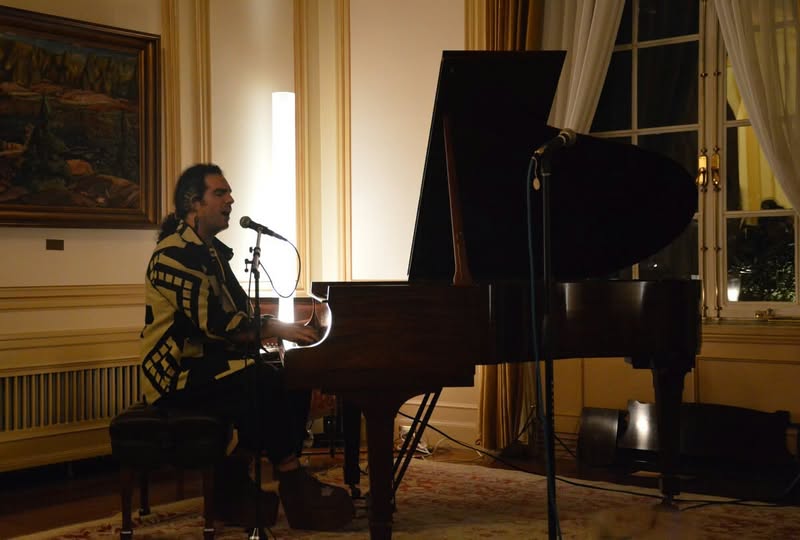

(Photo courtesy of PNA)
TOKYO — A cultural exchange at the 2025 World Exposition in Osaka has brought Canadian indigenous tenor Jeremy Dutcher back to Japan, where he joined Ainu musicians in a performance celebrating their shared heritage and the power of music to connect communities.
The concert, held Monday at the official residence of Canadian Ambassador to Japan Ian McKay in Tokyo, featured Dutcher alongside Ainu musician OKI, who plays the traditional stringed instrument known as the tonkori, and Marewrew, an all-female vocal group specializing in traditional Ainu singing.
The gathering highlighted the growing cultural connections between Canada and Japan as the two countries prepare to mark the centennial of their diplomatic relations in 2028.
“As Canada and Japan look toward the 100th anniversary of diplomatic relations in 2028, tonight reminds us that relationships grow through encounters, shared experiences and a willingness to listen,” said Laurie Peters, minister and deputy head of mission at the Canadian Embassy.
The performance combined the rhythmic sounds of the tonkori with traditional Ainu vocals, showcasing indigenous musical traditions and their role in preserving cultural identity.
“Music is a means of communication that does not rely on language,” OKI said, emphasizing its ability to bridge cultural and linguistic differences.
Dutcher said his first encounter with Ainu performers during an indigenous cultural event at the Osaka Expo in 2025 inspired him to return to Japan and collaborate with the musicians.
He recalled being moved by “the beauty of their songs and the strength of their culture,” describing the experience as an important moment in his artistic journey.
The Canadian singer also shared how he enthusiastically recounted the encounter to his friend, internationally renowned cellist Yo-Yo Ma.
“Every time I get to share a stage with (Ainu musicians), I understand a little more deeply how we are connected as indigenous people but also just as humans,” Dutcher said.
Dutcher belongs to the Wolastoqiyik indigenous community, whose ancestral territories extend across parts of New Brunswick and Quebec in eastern Canada and Maine in the United States.
The name Wolastoqiyik means “people of the beautiful river,” reflecting the community’s deep connection to its ancestral lands and waterways.
Like the Ainu people of Japan, the Wolastoqiyik face challenges in preserving their indigenous language.
According to Dutcher, fewer than 100 people who learned the Wolastoqiyik language from birth remain fluent speakers, raising concerns about its survival.
The Ainu language faces similar threats and has been classified by UNESCO as endangered.
Through his music, Dutcher works to preserve and revive his community’s cultural heritage by incorporating archival recordings of Wolastoqiyik ancestors dating back more than 110 years.
The historical recordings, preserved at the Canadian Museum of History, allow him to bring ancestral voices into contemporary musical performances.
Dutcher emphasized the importance of recognizing indigenous histories and understanding the cultural significance of ancestral territories.
He said learning about “the land we stand on” is essential to appreciating the traditions and experiences of indigenous communities.
“It’s a great honor and privilege for me to come and bring the songs of my people and my ancestors to this beautiful country of Japan,” Dutcher said.
The Tokyo concert underscored how the connections formed during the Osaka Expo continue to encourage artistic collaboration and cultural understanding between indigenous communities across national borders.

