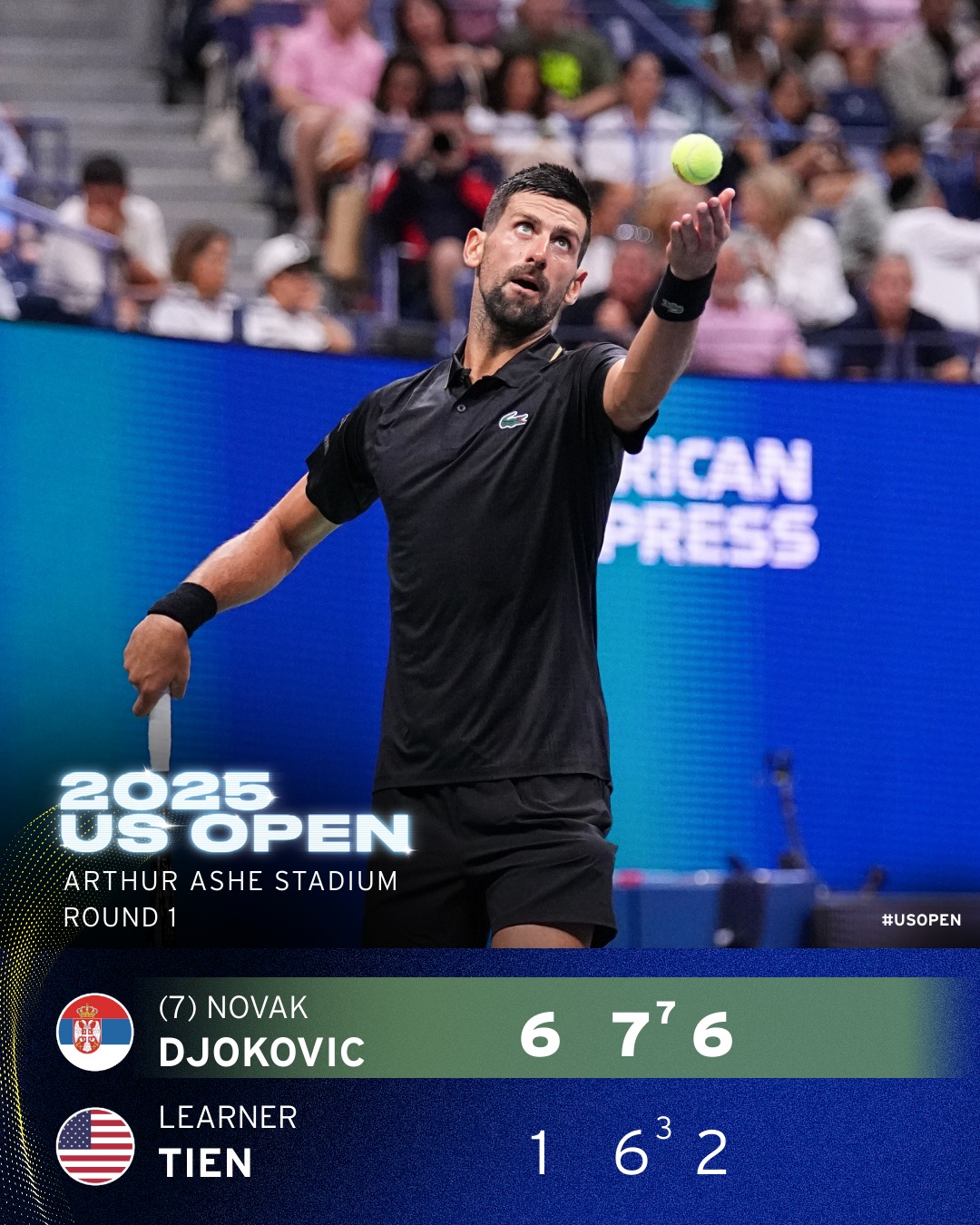

New York — The scene was familiar yet unsettling. Novak Djokovic, a 24-time Grand Slam champion whose career has been defined by endurance and unshakable resolve, was doubled over with his hands on his knees under the bright lights of Arthur Ashe Stadium. The crowd leaned forward, sensing both vulnerability and inevitability.
This was not the first time Djokovic had looked human, but it was perhaps the most telling. At 38, the Serbian legend opened his US Open campaign with a first-round win that carried as many questions as answers. He rolled through the first set in vintage fashion—razor-sharp returns, flawless movement, surgical precision. But then came the second set: nearly an hour of huffing, puffing, and a body that seemed unwilling to obey the mind that has long been tennis’s fiercest competitor.
“I don’t know what happened,” Djokovic admitted afterward. “I started well, felt great, then suddenly my body just… shut down in that second set. I was really surprised.”
Across the net stood 19-year-old Learner Tien, half Djokovic’s age, embodying the youth and energy of a sport increasingly defined by Carlos Alcaraz and Jannik Sinner. Tien pushed him into long rallies, tested his legs, and even forced Djokovic into a time violation that cost him a serve in the tiebreak. For a brief stretch, it felt like the future was staring the past directly in the face—and not blinking.
But Djokovic, as he has done for nearly two decades, found a way. After dropping serve early in the third set, he shifted gears, winning five straight games and closing out his 75th consecutive first-round Slam victory. The win wasn’t smooth, but it was a reminder: Djokovic doesn’t need to be flawless to be formidable.
This was his first match since Wimbledon, where a leg injury derailed his semifinal against Sinner. He also skipped the summer hard-court season, entering the US Open cold. Rust was expected. Fatigue? Perhaps inevitable. But fragility? That was new.
“Of course, I wish I had Tien’s age,” Djokovic said with a wry smile. “But that’s not possible. I just have to manage my body and keep fighting.”
For Tien, the verdict was clear: “I wouldn’t count him out. Djokovic has that ability to peak exactly when it matters most. He’s still dangerous.”
The US Open has always been a proving ground for Djokovic—New York crowds have seen his highest highs and most controversial moments. Now, they may be witnessing something different: the tightrope walk of a champion caught between dominance and decline.
As he eyes a possible collision with Alcaraz, the young king in waiting, the question looms larger than the draw itself. Is Djokovic still the immovable force capable of bending time to his will—or are we watching the slow, inevitable handover to a generation that no longer fears him?
For now, the scoreboard still reads “Djokovic wins.” But every set, every stumble, every labored breath feels like a chapter in a larger story—the one about how long greatness can last, and what happens when the clock finally runs out.